It's 10 am on a Saturday. Your 4-year-old has already hopped to the bathroom, raced you to the front door and climbed over the back of the sofa twice. You read somewhere that kids this age need 3 hours of physical activity a day, and it sounded impossible. Then you notice that every one of those hops counts.
The short answer: Children aged 3 to 4 need at least 180 minutes of physical activity a day, including at least 60 minutes of energetic play, says the World Health Organization (2019). From age 5, WHO recommends an average of 60 minutes a day of moderate to vigorous activity. For preschoolers, short bursts and gentle movement all count.
How much physical activity does a 3 or 4 year old need?
Children aged 3 to 4 need at least 180 minutes (3 hours) of physical activity a day, says the World Health Organization (2019). It can be spread through the day, and at least 60 minutes should be energetic play. WHO also says "more is better."
If "3 hours a day" made your stomach drop, here's the good news. The US Physical Activity Guidelines (2018) note that 3 hours is about the average amount of activity seen in children this age. So a realistic goal for most families is a few more bursts, not a new routine. In October 2026, Canada's first early-years report card found that 67% of under-5s already met the activity guideline (ParticipACTION, via the University of Alberta).
The 3 hours can be any intensity. Walking to the shop counts. So does playing standing up at a toy kitchen, dancing to one song or climbing the slide.
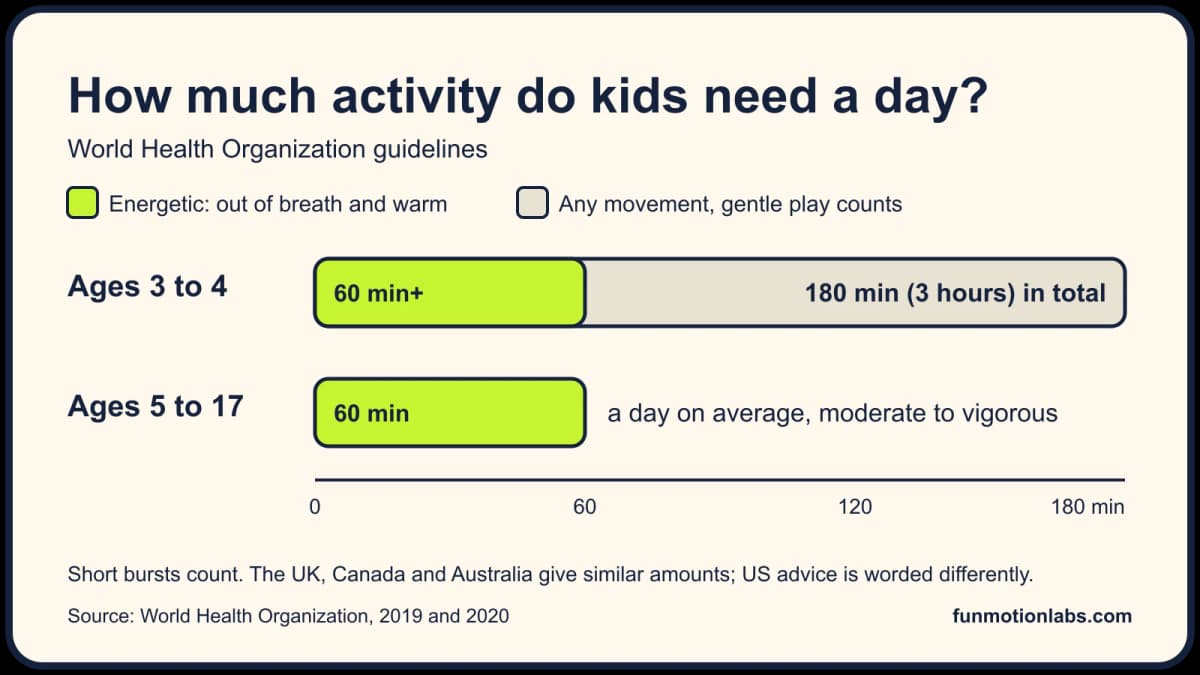
The UK, Canada and Australia give the same numbers for this age: 180 minutes, with at least 60 energetic. The US words it differently. The CDC says children aged 3 to 5 "should be physically active throughout the day." The US guidelines add that about 3 hours a day "may be" a reasonable target. So all five land on about 3 hours a day.
What counts as energetic play? Examples for kids by age
Energetic play is play that leaves your child out of breath and warm. WHO describes it as play "when children get out of breath and feel warm," like running, dancing or ball games. It counts as moderate to vigorous activity.
The guidelines give no official lists, so these examples are ours:
| Age | Light (counts for preschoolers) | Energetic | Muscle and bone |
|---|---|---|---|
| 3 to 4 | Walking to the shop, helping tidy | Chasing bubbles, dancing, running games | Climbing a play frame, hopping, animal walks |
| 5 to 6 | Walking, playing shop | Tag, freeze dance, fast scooting | Hopscotch, jumping, climbing |
| 7 to 8 | Walking the dog, gentle swinging | Races, soccer, dance games | Jump rope, climbing, push-up challenges |
Do short bursts of activity count?
Yes. Short bursts count, and they're how young children naturally move. The US guidelines (2018) say young children are "naturally active in an intermittent way." For preschoolers, they add, "activity of any intensity counts, including light intensity." WHO's 2020 guidelines put it plainly: "Doing some physical activity is better than doing none."
How much physical activity does a 5 year old need?
A 5-year-old's target depends on which guideline you read. WHO, the UK and Canada switch to about 60 minutes of moderate to vigorous activity a day from age 5. The US and Australia still group 5-year-olds with preschoolers, so their advice stays at about 3 hours of movement through the day.
The two numbers look far apart, but they measure different things. The 180 counts all movement, gentle play included. The 60 counts only the out-of-breath part. A 5-year-old who still plays like a preschooler, moving lightly most of the day with a few big bursts, meets both.
How much exercise does a 6, 7 or 8 year old need?
Children aged 6 to 8 need at least 60 minutes of moderate to vigorous activity a day. The CDC says 60 minutes or more "each day." WHO and the UK say an average of 60 minutes a day across the week. That way, a quiet Monday can be balanced by a busy Saturday at the park.
WHO (2020) and the CDC also ask for vigorous play and moves that build muscle and bone on at least 3 days a week. Running, jumping, climbing and jump rope all do the job.
If your child isn't there yet, you're with most families. In US national survey data, only about 1 in 5 children aged 6 to 17 are active for 60 minutes every day (America's Health Rankings, 2023 to 2024). One extra burst a day is a fine start.
WHO physical activity guidelines for children, side by side
If you've searched this at 9 pm and found five different answers, the age groups are the reason. Preschool means 3 to 4 for WHO, the UK and Canada, but 3 to 5 for the US and Australia. The US also says "each day" where WHO and the UK say "across the week."
| Guideline | Ages 3 to 4 | Age 5 | Ages 6 to 8 |
|---|---|---|---|
| WHO | 180 min, 60 energetic | 60 min a day, on average | 60 min a day, on average |
| US (CDC) | Active all day, about 3 hours | Active all day, about 3 hours | 60 min every day |
| UK | 180 min, 60 energetic | 60 min a day, on average | 60 min a day, on average |
| Canada | 180 min, 60 energetic | 60 min a day, plus light play | 60 min a day, plus light play |
| Australia | 180 min, 60 energetic | 180 min, 60 energetic | 60 min a day, plus light play |
"60 min" means moderate to vigorous activity. Canada and Australia also ask school-age kids for "several hours" of lighter movement.
How can kids get 3 hours on an indoor day?
Day three of rain. The cushions are already on the floor, and it isn't 10 am.
On an indoor day, 3 hours comes from many small pieces. Think 5 minutes of dancing, a hallway race, carrying the laundry, and one or two longer energetic bursts. A few ideas that need no equipment:
- Freeze dance: music on, everyone dances, everyone freezes when it stops.
- Animal walks down the hallway: bear crawl, frog jumps, crab walk.
- Floor is lava, with cushions as stepping stones.
- Balloon keepy-uppy: don't let it touch the floor.
- A movement game in front of a laptop webcam, like the ones we make at Fun Motion Labs, for days you can't go out.
Outdoor play is still the first choice when you can get out. This list is for the days you can't.
Try this today
Pick one or two. A day with one extra burst still counts.
- Count one morning. Note every time your child runs, climbs, dances or hops between 8 am and noon. You may find more than you expected.
- Add one out-of-breath burst before lunch: two songs of freeze dance.
- Swap one sitting slot for a moving one, like one show for a hallway race.
- For ages 5 to 8, plan one longer energetic block at the weekend to balance quieter weekdays.
Back to that Saturday. By lunch, the bathroom hops, the sofa climbs and one round of freeze dance are already on the tally, and nobody put on sneakers.
This is general information, not medical advice. If you're worried about your child's development, sleep or behavior, talk to your pediatrician or family doctor. For more on screens, safety and play at home, see our guide for parents, and how we check our sources.
FAQ
Does screen time count as physical activity?
Sitting screen time doesn't count. WHO advises no more than 1 hour a day of sedentary screen time for children aged 3 to 4, and says less is better. WHO defines sedentary screen time as passive watching, and its definition leaves out screen games where the child has to move. Active screen games are still an extra, and they don't replace running, climbing and playing outside.
Does walking count as physical activity for kids?
Yes, walking counts. For preschoolers, the US guidelines say activity of any intensity counts, so every walk goes toward the 3 hours. WHO lists brisk walking among the activities that can leave young children hot and breathless, so a fast walk can count as energetic too. For children 6 and up, the 60-minute target is for moderate to vigorous activity, so a gentle stroll is a bonus on top.
How many steps should a 4-year-old take a day?
There is no official step target for young children. A 2011 research review found only limited evidence. Its best estimate was roughly 10,000 to 14,000 steps a day for active preschoolers, and the authors called it preliminary. Noticing how often your child moves through the day is more useful than counting steps.
Can kids exercise too much?
WHO's guidelines for young children set a minimum and say "more is better" for ages 3 to 4. They give no upper limit for everyday play. If your child has pain, unusual tiredness or seems pushed too hard in a sport, talk to your doctor.
Why do kids need 60 minutes of physical activity?
According to WHO, physical activity builds healthy bones and muscles and supports children's motor and thinking development. The CDC lists better attention and memory, stronger bones and muscles, and a lower risk of depression among the benefits of regular activity for children. The 60 minutes applies from age 5 (age 6 in the US).
Sources
- World Health Organization (2019). To grow up healthy, children need to sit less and play more.
- World Health Organization (2019). Guidelines on physical activity, sedentary behaviour and sleep for children under 5: glossary.
- World Health Organization (2020). Guidelines on physical activity and sedentary behaviour for children and adolescents aged 5 to 17, International Journal of Behavioral Nutrition and Physical Activity.
- World Health Organization (2024). Physical activity fact sheet.
- CDC (2026). Child activity: an overview and Health benefits of physical activity for children.
- US Department of Health and Human Services (2018). Physical Activity Guidelines for Americans, 2nd edition, summarized in JAMA.
- UK Chief Medical Officers (updated July 2026). Physical activity guidelines.
- Canadian Society for Exercise Physiology. 24-Hour Movement Guidelines for the Early Years and for Children and Youth.
- Australian Government. 24-Hour Movement Guidelines for the Early Years and for Children and Young People.
- University of Alberta (October 2026). Canada's youngest generation off to healthy start, but screen time is a challenge (ParticipACTION Early Years Report Card).
- America's Health Rankings. Physical activity, children (National Survey of Children's Health, 2023 to 2024).
- Tudor-Locke C and others (2011). How many steps/day are enough? for children and adolescents, International Journal of Behavioral Nutrition and Physical Activity.
Chart: Fun Motion Labs. Cover photo by Pavel Danilyuk on Pexels.
We cite health bodies for health facts and never claim our games change your health. Our editorial policy