It's 7:45 pm. Bath done, teeth done, pajamas on, and your 4-year-old is doing laps of the hallway like it's 9 in the morning. You're running on empty. They seem to have just been plugged in.
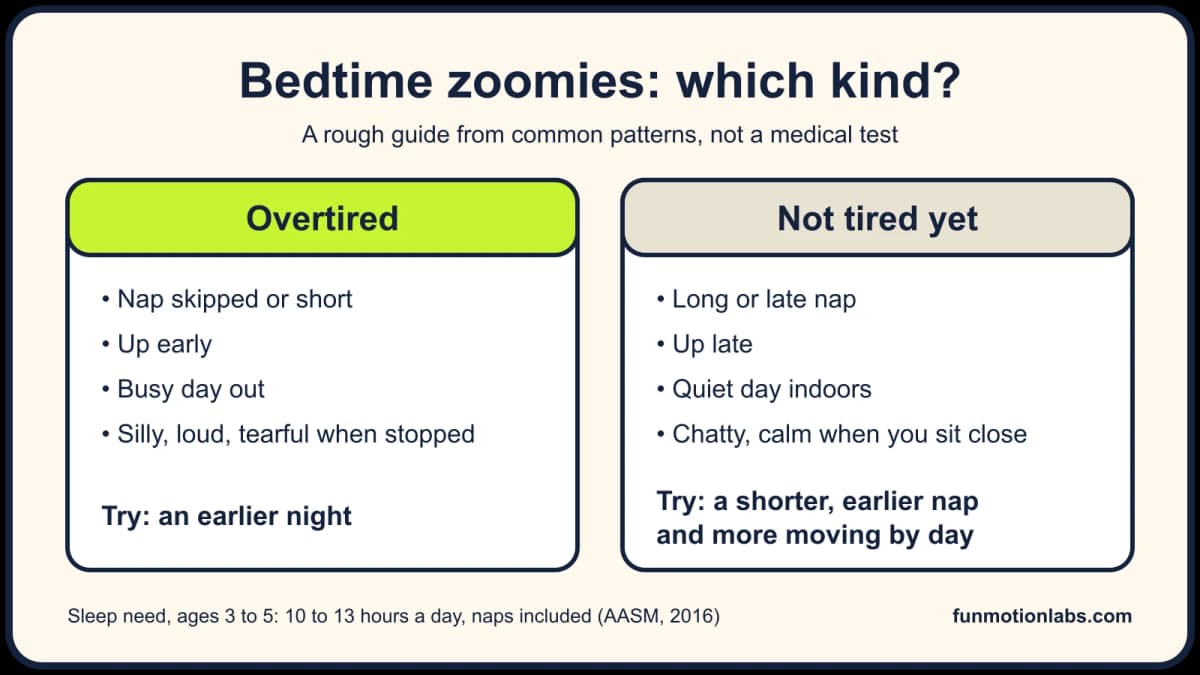
The short answer: Bedtime bursts of energy often point to one of two patterns: an overtired child on a "second wind," or a child who isn't tired yet after a long or late nap. Children aged 3 to 5 need 10 to 13 hours of sleep a day, naps included (American Academy of Sleep Medicine, 2016).
The two patterns need different fixes, so it helps to know which one you're looking at. Here's how to tell, and a calm plan for tomorrow evening.
Is it normal for a 3 or 4 year old to have so much energy at night?
Yes, it's very common. We couldn't find research that counts how often it happens, but parents describe the "nighttime zoomies" so often that they fill parenting forums.
Young kids are built to move. The World Health Organization (2019) says children aged 3 to 4 need at least 180 minutes of activity a day, and that "more is better." A child who still wants to move at 7 pm is doing what young children do.
What matters is which kind of energy it is. This rough guide is based on common patterns, and it isn't a medical test.
| Clue | Probably overtired | Probably not tired yet |
|---|---|---|
| Nap today | Skipped or short | Long, or late in the afternoon |
| Wake-up time | Early | Late |
| The day | Busy, out a lot, or a big change | Quiet, mostly indoors |
| How it looks | Silly, loud, tearful when stopped | Chatty, calm when you sit close |
Why does my child get a second wind at bedtime?
Overtired kids rarely look sleepy. They often look wired. They get silly, loud and fast, and fall apart when you try to stop them. It's maddening.
Parents and sleep advisers have long called this a "second wind." We couldn't find good research on what causes it in young children, so we won't pretend to explain the biology. The triggers parents describe most are a short or skipped nap, a bedtime that has crept later, and a long, exciting day out.
Parents and sleep advisers usually try an earlier night first. The NHS suggests a calm routine that happens "at the same time and includes the same things every night." Start winding down about 30 minutes before your child usually falls asleep. If bedtime has drifted late, the NHS suggests moving it earlier by 5 to 10 minutes a week.
Could my child just not be tired yet?
Some children aren't overtired at all. A long afternoon nap or a late wake-up has pushed their sleep later. If they napped until 4, a 9 pm chat in bed isn't a mystery.
The American Academy of Sleep Medicine recommends 10 to 13 hours of sleep a day for ages 3 to 5, naps included (Journal of Clinical Sleep Medicine, 2016). So a long nap can come straight off the night. The NHS advice for young children is to "avoid long naps in the afternoon."
Some 4 and 5 year olds still nap and some have stopped. If nap days end in bedtime battles, you could keep the nap early and short, or swap it for quiet time a few days a week.
Does running them ragged help them sleep?
Not reliably. Being active is good for children in many ways. But a 2020 review of 47 studies of children aged 3 to 13 found "little association" between physical activity and sleep (Sleep Medicine Reviews). So a busy day doesn't guarantee an early night. If you've tried "just tire them out" and it didn't work, you're not doing it wrong.
Moving in the daytime is still worth it for its own sake, especially on indoor days. Here's more on how much activity kids need each day.
Do screens and bright lights before bed make kids more awake?
Bright light in the hour before bed can hold back a young child's sleep signal. The NHS advises: "Do not let your child look at laptops, tablets or phones in the 30 to 60 minutes before bed," because the light from screens can interfere with sleep.
One small lab study shows why light matters. Ten children aged 3 to 5 spent an hour in bright light before bed. Their melatonin, the body's "time to sleep" signal, dropped by about 88%, and it was still low 50 minutes later (Physiological Reports, 2018). That was very bright light from a light table, and only 10 children. It's a clue about bright light. It proves nothing about tablets.
If a show or a tablet is part of falling asleep in your house, you have company. About 1 in 5 US children aged 8 and under use a device to fall asleep every night or most nights (Common Sense Media, 2025). One gentle swap to try is an audio story with the lights low.
When should I talk to a doctor about my child's energy at night?
Talk to your pediatrician or family doctor any time you're worried about your child's sleep or behavior. The American Academy of Pediatrics asks doctors to check whether children snore, and snoring 3 or more nights a week is worth mentioning (Pediatrics, 2012). So are worries about behavior that last for weeks.
Move early, slow late: how to calm a hyper child before bed
You don't need a new system. Try one change from this list tomorrow and see what happens.
| When | What to do | Why |
|---|---|---|
| 4 to 6 pm | 20 to 30 minutes of energetic play: dancing, chasing, hallway races, or outside if you can | Gives the day's energy somewhere to go |
| After dinner | Slow play: building, drawing, puzzles, a bath | A change of gear |
| 30 to 60 minutes before bed | Screens away, lights low | NHS advice on screens |
| 30 minutes before sleep | The same wind-down every night: bath, pajamas, teeth, one story | NHS: same routine every night |
| If bedtime has crept late | Move it earlier by 5 to 10 minutes a week | NHS advice |
If a burst still comes, give it a place. One slow "zoomie lap" to a quiet song, then into bed.
Tomorrow, you could try the hallway laps at 5:15, before dinner, to two loud songs. If one more comes at 7:45, make it a slow one.
This is general information, not medical advice. If you're worried about your child's development, sleep or behavior, talk to your pediatrician or family doctor. You'll find more on screens, sleep and play in our guide for parents, and you can see how we check our sources.
FAQ
Why is my toddler or child hyper before bed?
A burst of energy before bed often points to one of two patterns. Your child may be overtired after a skipped nap, an early wake-up or a busy day. Or they may not be tired yet after a long or late nap or a quiet day indoors. Overtired children usually do better with an earlier night. Children who aren't tired yet may need a shorter or earlier nap and more moving in the daytime.
What are the signs of an overtired child?
Overtired children often get silly, loud, clumsy and fast, and melt down when you try to stop them. A skipped or short nap, an early wake-up or a long, exciting day often comes first. An earlier night is the usual first thing to try.
Is it normal for a 5-year-old to have so much energy at night?
Yes, it's common at 5 too. If your 5-year-old no longer naps, a bedtime burst is more likely the overtired kind. The American Academy of Sleep Medicine recommends 10 to 13 hours of sleep a day at age 5. Canada's guidelines suggest 9 to 11 hours a night from age 5. If evenings are wild, try bedtime a little earlier for a week and watch what changes.
Should I drop my 4-year-old's nap?
There's no set age to drop the nap, so watch your child rather than the calendar. The 10 to 13 hours of sleep a day for ages 3 to 5 includes naps, so a long nap can mean a later bedtime. The NHS suggests avoiding long naps in the afternoon. If a nap is ruining bedtime, try a shorter, earlier nap or quiet time instead before dropping it altogether.
Sources
- Paruthi S and others (2016). Recommended amount of sleep for pediatric populations. American Academy of Sleep Medicine, Journal of Clinical Sleep Medicine.
- World Health Organization (2019). To grow up healthy, children need to sit less and play more.
- NHS (reviewed 2023). Sleep and young children.
- Antczak D and others (2020). Physical activity and sleep are inconsistently related in healthy children. Sleep Medicine Reviews.
- Akacem LD, Wright KP and LeBourgeois MK (2018). Sensitivity of the circadian system to evening bright light in preschool-age children. Physiological Reports.
- Common Sense Media (2025). The Common Sense Census: Media Use by Kids Zero to Eight.
- Marcus CL and others (2012). Diagnosis and management of childhood obstructive sleep apnea syndrome. American Academy of Pediatrics, Pediatrics.
- Canadian Society for Exercise Physiology. 24-Hour Movement Guidelines for Children and Youth.
Card: Fun Motion Labs. Cover photo by RDNE Stock project on Pexels.
We cite health bodies for health facts and never claim our games change your health. Our editorial policy