
Your 6-year-old is stomping along to a dance game, red in the face, copying every move on the screen. "It's still screen time," you think, "but at least they're moving." So is it exercise, or just "better than nothing"? Both halves of that thought are fair, and the research says a lot about when each one applies.
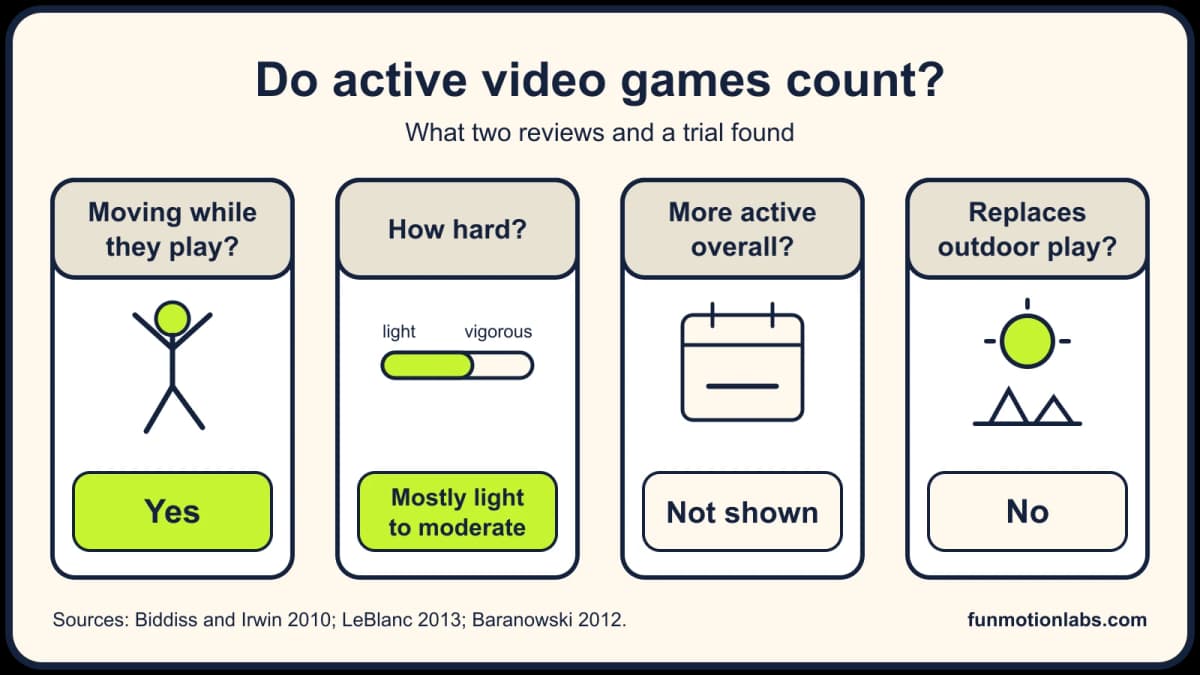
The short answer: Active video games count as exercise while a child is playing them. A 2010 review of 18 studies found they raised children's energy use well above resting levels, mostly at light to moderate effort. But a 2012 trial found that owning one didn't make kids more active overall, so they work best as an extra.
We make Fun Motion Labs, a set of webcam motion games, so weigh what we say with that in mind. Tracking and voice commands run on your computer. Your webcam video is never saved or uploaded. Every claim below links to its source, and our editorial policy explains how we choose them.
Do active video games count as exercise?
Active video games count as physical activity while children play them. Research reviews find they raise energy use well above sitting, usually to a light-to-moderate level.
Active video games are games you control by moving your body, through a camera, a balance board or motion controllers. Researchers often call them "exergames." So can video games be a form of exercise? The ones that get your child up and moving can.
The best-known summary is a 2010 review of 18 studies in children and teens. Active games raised energy use well above resting levels. The authors said the games "enable light to moderate physical activity."
Light means moving while breathing normally, like wandering around the room. Moderate to vigorous is what the World Health Organization calls energetic play for young children. That's when they "get out of breath and feel warm" (WHO glossary, 2019).
WHO's 2020 guidelines for ages 5 to 17 put the bigger picture plainly: "Doing some physical activity is better than doing none." Light minutes are still minutes.
Are motion games moderate or vigorous activity?
Most motion games put children in the light-to-moderate range. Some sessions reach moderate effort, and few reach vigorous.
A 2024 review of 23 studies in 9 to 17 year olds found many game sessions reached moderate intensity in the moment.
The study closest to a webcam game is older. In a 2006 Mayo Clinic lab study, 25 children aged 8 to 12 played Sony's EyeToy, a camera-based game that read their moves without a controller. Their energy use rose 108% above resting. Seated video games raised it by 22%. The authors summed it up this way: "Energy expenditure more than doubles when sedentary screen time is converted to active screen time." That was one session in a lab with older children, so it describes the moment rather than the week.
Games that use the whole body, especially the legs, get children moving more than games played mostly with the arms. The 2010 review found energy use was "significantly lower for games played primarily through upper body movements." A 2019 lab study of 8 to 12 year olds tested three movement games. One played mostly by swiping the arms was the least active, and a whole-body game was the most.
Do active games make kids more active overall?
Not on their own, going by the studies so far. A 2012 trial found that giving children active video games at home didn't make them more active overall. Later reviews say lasting effects are uncertain.
That trial, published in Pediatrics, is worth a closer look. Researchers gave 84 children aged 9 to 12 a Wii console. Half got two active games and half got two seated games. Over 13 weeks, the children wore activity monitors for a week at a time, five times. The active-game group was no more active in general. The authors saw "no reason to believe" that an active game at home, "under naturalistic circumstances," brings children a public health benefit.
A 2013 review of 51 studies, covering ages 3 to 17, drew the same line between the moment and the long run. It used two research words for it. Active games bring "acute increases" in energy use, which means while the game is on. Their effects on "habitual physical activity," how active a child is across ordinary days and weeks, "are not clear."
Newer work lands in the same place. A 2025 overview of 20 reviews found active games work "during their use," with lasting effects less certain. The 2024 review found longer programs didn't clearly change children's overall activity either.
The research on children 8 and under is newer and thinner. A 2026 review of studies in children 8 and under linked active-game programs to more physical activity. Their effects on motor skills, working memory and self-control were not significant. Another 2026 review, of 4 to 12 year olds, found movement games did about as well as traditional activities for basic movement skills. It used an unusual type of analysis, so treat it as a hint. Both looked at organized programs, often at school, which is a long way from a game in the living room.
Are active video games as good as playing outside for a 6-year-old? None of the reviews we read makes that claim, and the 2013 review stopped short of recommending them as a way to raise daily activity. Active games are an extra way to move, alongside outdoor play, sport and free play. They still count as screen time. Our post on active vs passive screen time looks at how WHO's limits treat them.
The verdict, question by question
The evidence is strongest that active games get children moving while they play, and weakest on whether owning one makes them more active overall.
| Question | What research found | How strong | Main sources |
|---|---|---|---|
| Do kids move more while playing? | Yes, well above resting and above seated games | Strong: many lab studies and reviews | 2010 and 2013 reviews; 2006 lab study |
| How hard is it? | Mostly light to moderate; whole-body games beat arm-only | Moderate: lab studies, mostly ages 8 and up | 2010 and 2024 reviews; 2019 lab study |
| Does owning one make kids more active overall? | Not shown | Moderate: one good trial plus reviews | 2012 trial; 2025 overview |
| What about children 8 and under? | More activity in programs; motor skills no different | Early: one 2026 review, abstract only | 2026 reviews |
One limit runs through all of this. Most studies tested children aged 8 and up, in labs or school programs. None we found tested a webcam game at home with children aged 3 to 8.
Does the novelty of active games wear off?
Children usually enjoy active games at first, but the novelty can fade within weeks, and playing with someone else seems to help.
In a 2023 school study of 30 children around age 10, enjoyment scores slipped over 12 weeks. The drop was small enough that it could be chance. A 2008 study of about 27 children around age 10 compared a weekly group dance-game class with playing at home. Only 15% of the group class dropped out, against 64% at home. It was a tiny study, so read it as a pointer.
In parent forums, a common story about motion consoles is a few weeks of love, then dust. Some families rotate games every week or two. Others keep the game for a set moment, like a rainy afternoon before dinner.
Try this today
Nothing here needs a new purchase. If an active game already lives in your house, pick whatever fits your week.
- Standing up for active games gets more out of them than sofa mode.
- Games or levels that use legs, like stepping, squatting and dodging, are the ones to look for.
- You could play the first round with them, or invite a sibling in.
- Clearing 1.2 to 1.8 m (4 to 6 ft) of floor and pushing the coffee table back makes room to swing.
- On stuck-inside days, like when it's too cold to play outside, it's a handy extra next to other indoor ways to burn off energy.
So, does tonight's stomping dance-off count? For the minutes your child is moving, yes. The park and the floor-is-lava game can cover the rest.
FAQ
Is Just Dance good exercise for kids?
Just Dance can be good exercise for kids who copy the whole routine. Dance games use the whole body. The closest research is a 2012 lab study of 11 to 15 year olds, where a camera-based dance game raised energy use 150% above resting. Effort depends on the child. Copying the dancer fully is more active than waving one arm. As for whether Just Dance is safe for kids, the main risk is the room. Doctors have reported injuries when players hit furniture or walls (Sparks, 2009), so clear a space and anchor the TV (CPSC, 2024).
Do active video games count toward the 60 minutes a day?
Some active-game minutes can count toward the 60 minutes a day. WHO (2020) asks children aged 5 to 17 for an average of 60 minutes a day of moderate-to-vigorous activity across the week. Most active games are light to moderate, so some minutes reach that level and some won't. For ages 3 to 4, WHO (2019) counts activity "at any intensity" toward 180 minutes a day. There's more in how much activity kids need each day.
Is Nex Playground good exercise?
We found no published study of Nex Playground itself. It's a camera box that plugs into your TV (Nex, checked October 2026). So the best guide is research on older camera games. In lab studies of kids 8 and up, EyeToy and Kinect games raised energy use well above resting. Most of it was light to moderate effort. As with any active game, ones that use the legs get kids moving more than arm-only ones.
Can video games and VR be considered physical exercise?
Video games that get children up and moving count as physical activity while they play, as described above. VR headsets work differently, and the studies in this post are about games played in front of a TV or computer screen. So we can't say how much a VR game moves a young child. If you're thinking about a headset, the maker's own age guidance is the place to start.
Sources
- Biddiss E and Irwin J (2010). Active video games to promote physical activity in children and youth: a systematic review. Archives of Pediatrics and Adolescent Medicine.
- World Health Organization (2019). Guidelines on physical activity, sedentary behaviour and sleep for children under 5: glossary.
- World Health Organization (2020). Guidelines on physical activity and sedentary behaviour for children and adolescents aged 5 to 17, International Journal of Behavioral Nutrition and Physical Activity.
- França C and others (2024). Estimated energy expenditure in youth while playing active video games: a systematic review. Sports.
- Lanningham-Foster L and others (2006). Energy expenditure of sedentary screen time compared with active screen time for children. Pediatrics.
- Hwang J and others (2019). Exploring energy expenditure and body movement of exergaming in children of different weight status. Pediatric Exercise Science.
- Baranowski T and others (2012). Impact of an active video game on healthy children's physical activity. Pediatrics.
- LeBlanc AG and others (2013). Active video games and health indicators in children and youth: a systematic review. PLoS One.
- Vera-Ponce VJ and others (2025). Effectiveness of active video games for promoting physical activity: an umbrella review. Frontiers in Sports and Active Living.
- Kwok TMK and others (2026). Effects of exergaming on motor skills, cognitive skills, and physical activity among children in early childhood: a systematic review and meta-analysis. Journal of Physical Activity and Health.
- O'Brien O and others (2026). The effects of exergames on fundamental movement skills in childhood: a systematic review and meta-analysis. Sports Medicine Open.
- Röglin L and others (2023). Evaluating changes in perceived enjoyment throughout a 12-week school-based exergaming intervention. Children.
- Chin A Paw MJ and others (2008). The motivation of children to play an active video game. Journal of Science and Medicine in Sport.
- Smallwood SR and others (2012). Physiologic responses and energy expenditure of Kinect active video game play in schoolchildren. Archives of Pediatrics and Adolescent Medicine.
- Sparks D and others (2009). Wii have a problem: a review of self-reported Wii related injuries. Informatics in Primary Care.
- US Consumer Product Safety Commission (2024). Ahead of Sunday's game, CPSC reminds families to tackle the deadly hazard of TV and furniture tip-overs.
- World Health Organization (2019). To grow up healthy, children need to sit less and play more.
- Nex (checked October 2026). Nex Playground shop page.
Card: Fun Motion Labs. Cover photo by Ivan S on Pexels.
We cite health bodies for health facts and never claim our games change your health. Our editorial policy