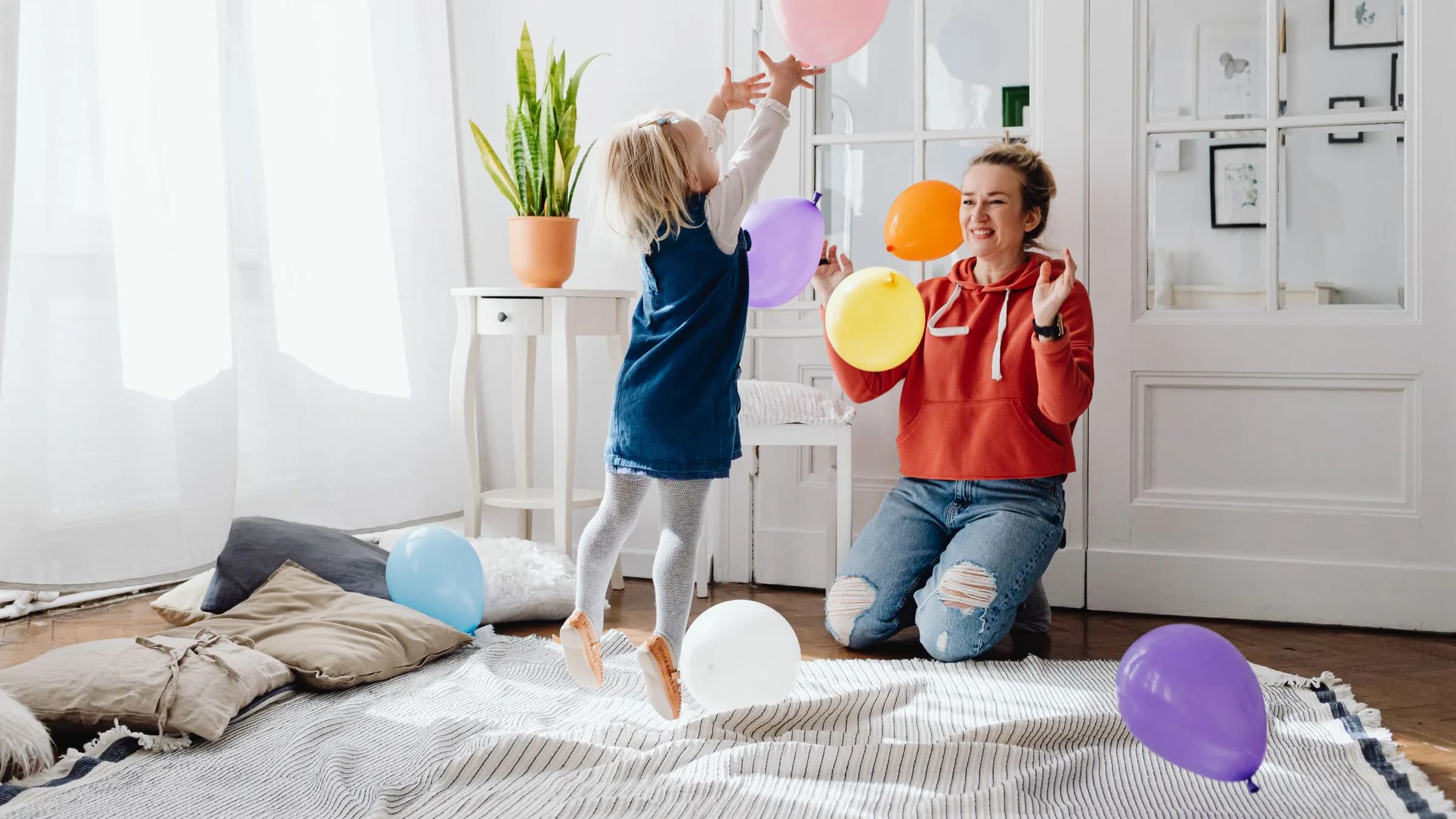
It has rained since breakfast. Lunch is eaten, and the sofa cushions have already been a fort, a boat and a mountain. It's 12:40, and your 4-year-old is bouncing off the walls, louder by the minute. Why does a day stuck inside make them wilder instead of calmer?
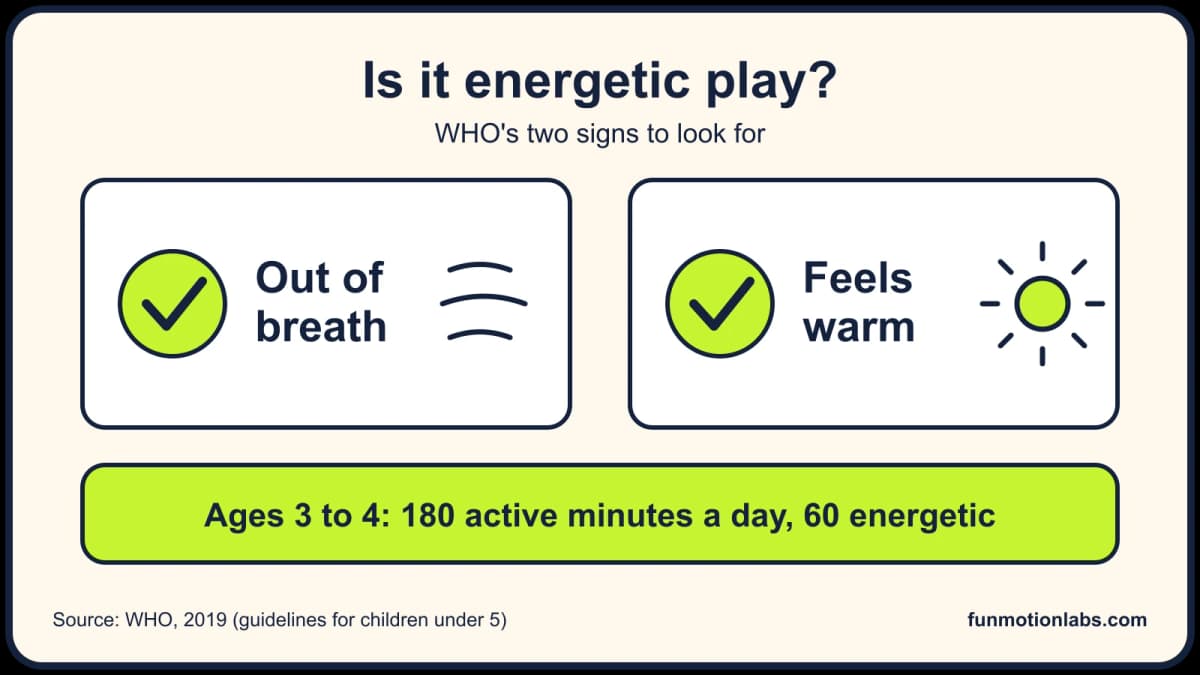
The short answer: To burn toddler and preschooler energy indoors, try short bursts of play that leave your child out of breath and warm, like freeze dance, hallway races or a cushion obstacle course, a few times a day. The World Health Organization (2019) says children aged 3 to 4 need at least 60 minutes of energetic play daily, spread across the day.
Why is my child bouncing off the walls on indoor days?
Children aged 3 to 4 need at least 180 minutes of activity a day, says the World Health Organization (2019). An hour of that should be energetic play. A day stuck indoors can leave a big gap, and the energy has to burn off somewhere.
Weather changes how much kids move. A study of more than 23,000 children in many countries found they moved less on days with rain, wind and shorter daylight (2017). The link was strongest in younger children. A small US study of preschoolers found their winter slump happened mainly at home, after preschool and on weekends (2013). So the dip tends to land on your watch, which is annoying, and also where a few games can make a difference.
There's more on how much activity a preschooler needs each day. On most days a coat and the park still win, so check when it really is too cold to go out. The ideas below are for the days that don't.
Indoor activities to burn energy, by space and time
The best indoor energy burners depend on the space you have. A hallway suits running games, a living room suits cushions and dancing, and one clear rug is enough for big moves that make little noise.
Ask other parents how to burn off a kid's energy inside, and the first thing they often ask back is how big your home is. So pick your row, then the minutes you need to fill. Every idea uses things most homes already have. They work as indoor activities for a 4 year old, and as rainy day activities for 4 year olds with older siblings joining in. Q means quiet (no jumping, fine for flats and napping siblings). L means loud.
| Space | 2 minutes | 10 minutes | 30 minutes |
|---|---|---|---|
| Hallway | Sprint and freeze to the end and back (L); crab-walk race (Q) | Animal-walk relay as a bear, frog, crab and penguin (L); walk a tape line forwards, then backwards (Q) | Bottle bowling, running to reset the pins each turn (L); "delivery driver", carrying soft toys end to end against a timer (L) |
| Living room | One-song freeze dance (L); chase the bubbles (L) | Floor is lava across cushions (L); balloon keepy-uppy (Q) | Cushion obstacle course with timed laps (L); dance party where the leader swaps every song (L) |
| One clear rug | Slow-motion superhero (Q); wall push-ups (Q) | Simon says with big moves, reaching high and squatting low (Q); paper-plate balloon tennis (Q) | Story yoga, acting out a story with animal poses (Q); a webcam game where you swing your arms, like Fruit Swipe (Q) |
These ideas are ours. A few need a word of setup.
In Fruit Swipe (ages 4+), you swing your arms to slice fruit in front of a laptop webcam. It needs about 1.2 to 1.8 m (4 to 6 ft) of clear space and no jumping. We make Fun Motion Labs, so weigh our pick with that in mind. Tracking and voice commands run on your computer. Your webcam video is never saved or uploaded.
For the cushion course, lay cushions in a loop, drape a blanket over two chairs for a tunnel, and time each lap. Kids often want to beat their own time, and you get to sit at the finish line holding the phone.
Balloon keepy-uppy has one rule. The balloon can't touch the floor. When that gets easy, add a second balloon, or try hands only, then feet only.
Slow-motion superhero is the one for flats and nap time. Your child flies, punches and lands as slowly as they can. Slow is harder than it looks, and it makes almost no sound.
How do I know if play is really burning energy?
Play is energetic when your child gets out of breath and feels warm, which is how the World Health Organization's under-5 guidelines (2019) describe it. Pink cheeks and fast breathing are the everyday signs.
Few young kids keep it up for a steady 10 minutes. The US Physical Activity Guidelines (2018) note that "children are naturally active in an intermittent way." Dash, flop on the rug, dash again is normal.
If you want to turn a game up, moves that use the legs and whole body are a good bet. Think bear crawls, frog jumps, squat jumps and running on the spot. In a lab study of movement games with 8 to 12 year olds (2019), games that worked the whole body got children moving harder than one played mostly with the arms. Those were older children, and we couldn't find research testing indoor games like these with 3 to 5 year olds at home. So treat it as a rule of thumb.
Some kids seem to need a lot more of this than their friends do. Indoor activities for high energy kids are mostly the same ideas, done more often. That fits WHO's own wording for ages 3 to 4: "more is better."
Mix in skill games for a calmer finish
Skills like throwing, catching and hopping don't just appear with age. A 2012 review of movement programs for children found these skills "need to be learned, practised and reinforced." Practice helped more than free play alone.
Living-room versions are easy. Roll socks into balls and throw them into a laundry basket. Play catch with a balloon first, then a soft ball. Tape a few squares on the floor to hop between, or walk a tape line like a tightrope. These are calmer than races, so they make a good end to a burst.
Any ideas that won't destroy my house? Start with a safe space
Before big indoor play, clear room to swing and land, and anchor TVs and heavy furniture to the wall. That's the advice of the US Consumer Product Safety Commission (2024). It reports that a child is treated in a US emergency department for a tip-over about every 53 minutes. If a TV isn't on the wall, the CPSC suggests a sturdy, low base, with the TV pushed back and cords out of reach.
The rest is quick. Push the coffee table to the side. Bare feet or grippy socks work better than plain socks on hard floors, and a rug makes a softer landing. "Any ideas that won't destroy my house?" is a fair question, and a cleared route answers most of it.
Try this today
Some days the goal is just to get the wiggles out before someone climbs the bookcase. That counts. Pick whatever fits.
- Find your row in the grid, then the minutes you need to fill.
- One-song freeze dance is an easy first burst.
- One option is a 10-minute energetic block before lunch and another in the late afternoon.
- Look for WHO's two signs, out of breath and warm. If they're not there yet, a faster game from the same row turns it up.
- Finish with a calm skill game, like the sock toss.
- If evenings run late, you could save the fast games for before dinner and the slow ones for after. There's more in why kids get a burst of energy at night.
By 3 pm the cushions have also been, for three rounds of floor is lava, actual lava. There are rolled-up socks under the sofa, your 4-year-old wants a snack, and the fort gets to stay up.
You'll find more on play and screens in our guide for parents, and you can see how we check our sources.
FAQ
What do you do with kids with too much energy?
Short, fast bursts of play spread through the day give that energy somewhere to go. WHO (2019) says children aged 3 to 4 need at least 60 minutes of energetic play a day, and that more is better. A lot of energy is often a child asking for exactly that. On an indoor day, the grid above has bursts from 2 to 30 minutes for any size of room.
How can I tire out kids indoors?
The games most likely to tire kids out indoors leave them out of breath and warm. Try an animal-walk relay, floor is lava or a timed cushion course. A few short rounds across the day fit the way young children move, with a calm skill game after each one. If you're really hoping for an easier bedtime, that's a separate question, and our post on evening energy covers it.
What can I do with a 3 year old on a rainy day?
Short, simple games from the 2- and 10-minute columns tend to suit a 3-year-old on a rainy day. One-song freeze dance, a crab-walk race and balloon keepy-uppy are easy starts. Keep the rules tiny, such as "the balloon can't touch the floor." End with something calm, like rolling a sock into a basket, then a snack and a book before the next burst.
Is it OK to let kids run inside?
That's a family choice, and plenty of homes have a no-running rule for good reasons. If you do allow it, a clear route and a rug at the turning point help. So do bare feet or grippy socks on hard floors. Whatever the house rules, the CPSC advises anchoring TVs and heavy furniture to the wall.
Sources
- World Health Organization (2019). To grow up healthy, children need to sit less and play more.
- Harrison F and others (2017). Weather and children's physical activity; how and why do relationships vary between countries? International Journal of Behavioral Nutrition and Physical Activity.
- Shen B and others (2013). An exploratory study of seasonality and preschoolers' physical activity engagement. Journal of Physical Activity and Health.
- World Health Organization (2019). Guidelines on physical activity, sedentary behaviour and sleep for children under 5: glossary.
- US Department of Health and Human Services (2018). Physical Activity Guidelines for Americans, 2nd edition.
- Hwang J and others (2019). Exploring energy expenditure and body movement of exergaming in children of different weight status. Pediatric Exercise Science.
- Logan SW and others (2012). Getting the fundamentals of movement: a meta-analysis of the effectiveness of motor skill interventions in children. Child: Care, Health and Development.
- US Consumer Product Safety Commission (8 February 2024). Ahead of Sunday's game, CPSC reminds families to tackle the deadly hazard of TV and furniture tip-overs.
Card: Fun Motion Labs. Cover photo by Kaboompics.com on Pexels.
We cite health bodies for health facts and never claim our games change your health. Our editorial policy