
It's 4:52 pm. The pasta water is on, the baby is on your hip, and your 3-year-old is running laps around the kitchen island like it's a racetrack. You've said "walking feet" four times. The TV remote is starting to look like a very good idea.
The short answer: The witching hour is the late-afternoon stretch, often 4 to 6 pm, when many toddlers and preschoolers get wild and quick to melt down. Research hasn't studied it by name. One order to try is about 10 minutes of big movement, then a calm job, then dinner. The NHS (2025) says under-5s shouldn't be inactive for long periods.
What is the witching hour for a toddler or preschooler?
The witching hour is the part of late afternoon, usually 4 to 6 pm, when many toddlers and preschoolers get louder and quicker to fall apart. It's a parent's name for it. Doctors don't use it as a diagnosis.
Most of what's written about the witching hour is about babies and their evening fussiness. We couldn't find a single study of it in children aged 3 to 6. What we did find is a lot of parents describing it, often down to the minute. They call it "5:00 chaos" or "4:30 chaos". Plenty say the toddler witching hour was still going strong when their child turned 4 years old.
If 5 pm is the toughest time of day in your house, you're in a big club.
Why do kids fall apart in the late afternoon?
Late-afternoon meltdowns tend to come from several small things piling up at once. A long day, a short nap, hunger and a lot of sitting all land around 4 pm. Often they land on a grown-up who is running low too. Some of this has research behind it, and some is what parents notice.
Naps are one piece. In a small 2012 study, ten children aged 2.5 to 3 skipped one nap. Afterward they showed less joy when a puzzle went well and more frustration when it didn't. That's only 10 children, all on the young side. Still, many parents will know the pattern from the months when the nap starts to wobble.
Then there's sitting. Many afternoons mean a car seat, a stroller, circle time and a wait at the gate. The NHS (2025) says "Children under 5 should not be inactive for long periods, except when they're asleep." The US guidelines (2018) add that young children are "naturally active in an intermittent way," moving in short bursts. By 4 pm, a lot of those bursts may be waiting to come out.
Lunch was also a long time ago. Plenty of parents swear by a snack at pickup, and it's an easy one to test.
And there's you. Lots of parents describe 5 pm as the moment they hit their wall. Your empty tank is part of the picture too. That's the math of a long day.
Why does my child melt down after daycare or school?
Lots of parents say their child holds it together all day at daycare, nursery or school, then falls apart soon after getting home. Some parenting educators call this "after-school restraint collapse." The term is credited to parenting educator Andrea Loewen Nair. It's a description of what many parents see rather than a research finding.
A preschooler meltdown after daycare can look like this. The teacher says they were lovely all day. Ten minutes after pickup, they're face down on the hall floor over the wrong cup.
Some parents hold off on "How was your day?" for the first 10 minutes and hand over a snack instead. Movement can come once you're home.
A 4 to 6 pm plan: move first, then a calm job, then dinner
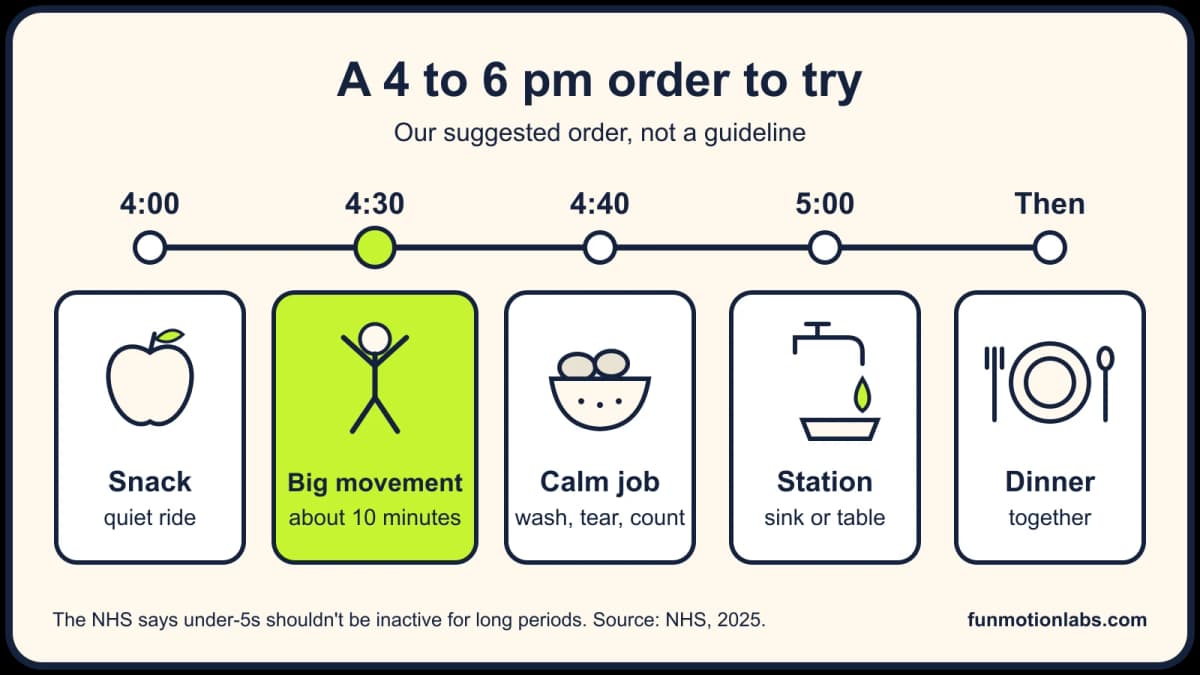
When kids are wild before dinner, one order to try is about 10 minutes of big movement, a calm job near you, then dinner.
The 10 minutes is our suggestion, sized for a tired evening. It doesn't come from any guideline. The US Physical Activity Guidelines (2018) say "For preschool-aged children, activity of any intensity counts," so there's no minimum to hit. If your child has more to burn, longer is fine.
| Roughly when | Your child | You | Why |
|---|---|---|---|
| Pickup, about 4:00 | Snack, a quiet ride or walk | Say little, hand over food | Hunger and questions can wait (parent experience) |
| 4:30 to 4:40 | Big movement: dancing, animal races, cushion hops | Call out moves from the counter | Under-5s shouldn't be inactive for long (NHS, 2025) |
| 4:40 to 5:00 | A calm job: washing potatoes, tearing lettuce, counting forks | Cook | Busy hands, close to you |
| 5:00 to dinner | A station: water play at the sink, a basket of kitchen tools | Finish cooking | Low mess, little watching needed |
The times are a rough guide. Slide the whole thing earlier or later to fit your pickup.
No plan stops every meltdown. This one gives the energy somewhere to go before you need both hands for the pan.
After dinner, the evening can slow down with a bath, books and calm play. If the energy comes back at bedtime, we've written about why kids get a burst of energy at night. And if your child asks you to play after dinner, Dr. Michael Yogman, lead author of the American Academy of Pediatrics' 2018 play report, keeps it short. "The next time your child wants to play with you, say yes" (HealthyChildren.org, 2018).
What to do with kids while cooking dinner
What you can do with kids while cooking dinner (or tea, in much of the UK) depends on how much you have left. "How are you managing to cook dinner?" comes up again and again in parent groups, often from someone holding a baby. These ideas are sorted by your energy, not theirs. For a longer list, see our indoor ways to burn off energy.
If you can stand at the stove
- "Touch something red, then come back." Change the color each round.
- Animal walks to the fridge and back, as a bear, a crab or a frog.
- Freeze dance, with the kitchen timer as the judge.
- We make Fun Motion Labs, so weigh this one with that in mind. If there's a laptop with a webcam in the next room and 1.2 to 1.8 m (4 to 6 ft) of clear floor, a motion game can be one 10-minute option. In Fruit Swipe, your child swings their arms to slice flying fruit. Tracking and voice commands run on your computer. Your webcam video is never saved or uploaded.
If you're holding a baby
If you're alone at 5 pm with a crying baby on your hip, these games let a wild 4-year-old move while you stay put.
- Simon says, from wherever you're standing.
- Hallway races you start with "ready, steady, go".
- Keep a balloon off the floor for as long as they can.
- A line of painter's tape to walk like a tightrope.
If you're on a work call
- A "mission card" made earlier in the day: 10 jumps, 5 crab steps, bring me something blue.
- A timer your child gets to start and stop.
- A show, if that's what gets you through the call.
Is it OK to put the TV on at 5 pm?
Yes, putting the TV on at 5 pm is something many families do to get dinner made. It's a normal way to get through the evening.
If a screen is part of your late afternoon, you have company. In a 2025 Common Sense Media survey of US families, 17% of children aged 8 and under used a device to calm down. Nearly a quarter (23%) used one at meals.
A couple of small changes can make the show easier to switch off. Movement first and the show second is one order. One episode with a clear end is easier to stop than autoplay.
How you use the show matters too. A 2026 Singapore study of preschoolers found that parents watching and talking about media with their child mattered more for kind, helpful behavior than total screen time. It's a link that doesn't prove cause. Asking about the show over dinner is an easy way in.
For numbers by age, see screen time by age. For the difference between sitting and moving screens, see active vs passive screen time.
Try this today
Some nights the plan is just getting everyone fed. That's enough.
- A snack in the bag before pickup is an easy first step.
- At 4:30, you could set a 10-minute timer for the loudest game you can stand.
- One calm kitchen job, like washing potatoes or counting forks, keeps small hands busy near you.
- A sink or table station set up before you start cooking can buy you some time.
- If a show is part of the evening, after the movement is one good slot.
Back at 4:52, the laps around the island are allowed. Ten minutes on the timer, then a colander of potatoes to wash.
This is general information, not medical advice. If you're worried about your child's development, sleep or behavior, talk to your pediatrician or family doctor. There's more on play and screens in our guide for parents, and you can see how we check our sources.
FAQ
What time does the witching hour start?
The witching hour for a toddler or preschooler usually starts somewhere between 4 and 5 pm, parents say. It tends to follow the shape of the day more than the clock. It often begins around pickup or when dinner prep starts, so a later pickup can push it later. We found no study that has timed it.
How long does the witching hour last?
Parents usually describe the witching hour with a toddler as an hour or two, easing once dinner is eaten. There's also no set age when it stops for toddlers and preschoolers. Many parents find it fades as naps settle and the after-school routine becomes familiar. If meltdowns are long, very frequent or worrying you, your pediatrician or family doctor is a good person to ask.
How do I cook dinner with a toddler running around?
Many parents give a toddler a calm job close by, such as washing potatoes, tearing lettuce or counting forks into a pile. A sink station with a little water and some cups, or a basket of safe kitchen tools on the floor, can buy you more time. Keep the job well away from the stove and knives.
Sources
- NHS (reviewed 2025). Physical activity guidelines for children (under 5 years).
- Berger RH and others (2012). Acute sleep restriction effects on emotion responses in 30- to 36-month-old children. Journal of Sleep Research.
- US Department of Health and Human Services (2018). Physical Activity Guidelines for Americans, 2nd edition.
- American Academy of Pediatrics (2018). Want creative, curious, healthier children with 21st century skills? Let them play, according to the American Academy of Pediatrics. HealthyChildren.org.
- Common Sense Media (2025). The Common Sense Census: Media Use by Kids Zero to Eight.
- Chen X and Yeung WJ (2026). Association between preschool children's media use, parental joint media engagement and prosocial behavior: a longitudinal cohort study. BMC Public Health.
Card: Fun Motion Labs. Cover photo by kenan zhang on Pexels.
We cite health bodies for health facts and never claim our games change your health. Our editorial policy