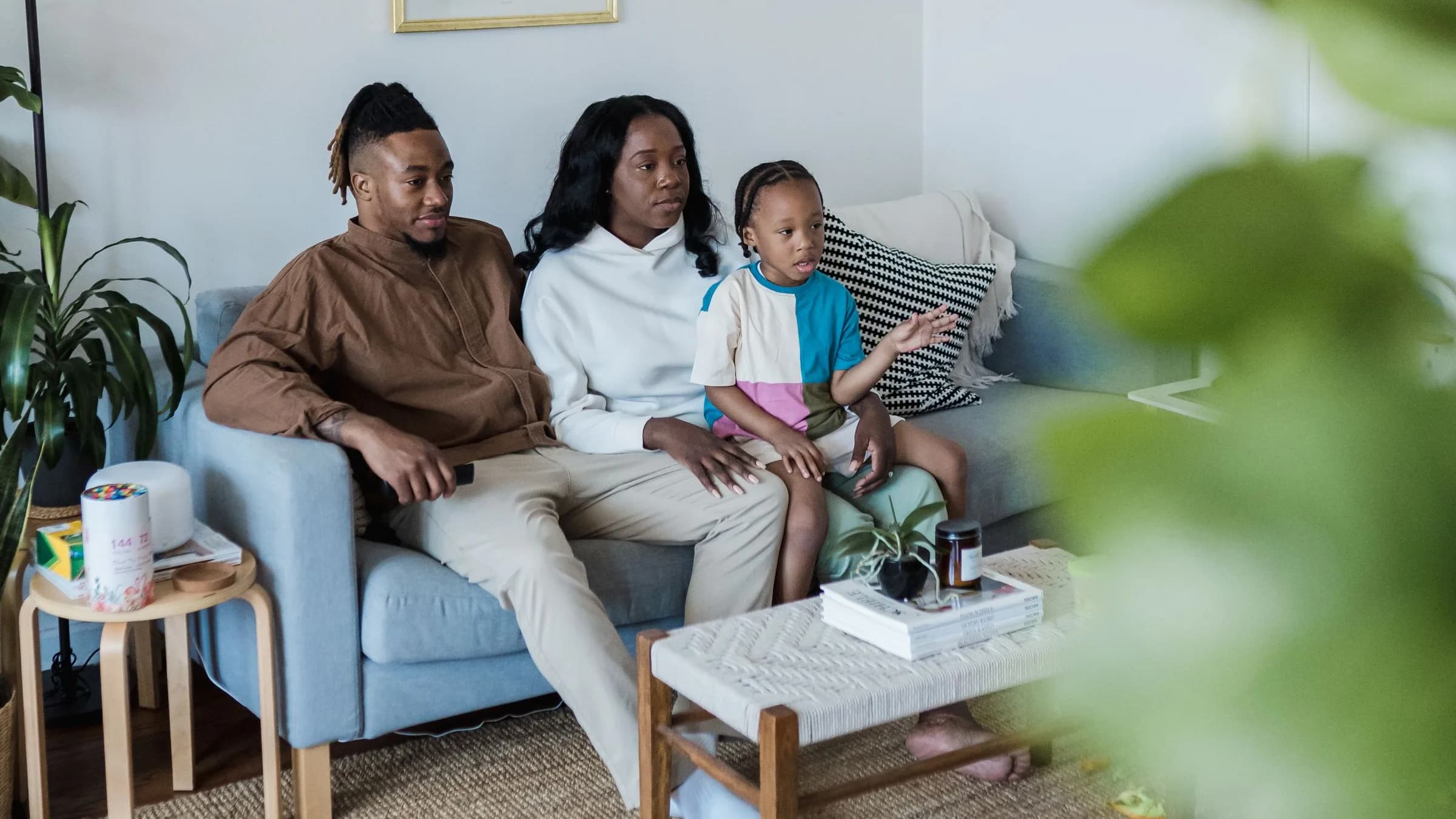
The show ends, and you glance at the clock. Did you stay under the hour? Then a friend asks, "Be honest, how much TV do they watch?" and the mom guilt (dads get it too) shows up right on time. If you've searched how much screen time for a 4 year old since, the numbers didn't match. Two of them changed in 2026.
The short answer: For ages 3 to 4, the World Health Organization (2019) advises no more than 1 hour a day of sitting screen time, and says less is better. Canada (2017), Australia (2017) and England (2026) set the same hour. The AAP's January 2026 announcement gives no daily number; one AAP parent page still suggests less than 1 to 2 hours at age 4.
How much screen time for a 4-year-old?
For a 4-year-old, the most common guideline is no more than 1 hour of screen time a day. WHO, Canada, Australia and England all land on that hour, and it's the same answer for how much screen time a 3-year-old should have.
The World Health Organization's 2019 guidelines for under-5s say: "Sedentary screen time should be no more than 1 hour; less is better." Sedentary means sitting or lying still. For younger children, WHO doesn't recommend any screens for 1-year-olds and sets the same 1-hour cap for 2-year-olds. So the WHO screen time guidelines are about sitting screens, and they don't say what to do with a dance video or a movement game. We look at that gap in active vs passive screen time.
Canada's guidelines (2017) give the same hour for ages 3 to 4. Australia's (2017) do too, for a slightly wider band of 3 to 5.
The newest number comes from England. In March 2026, the UK government published screen time guidance for under 5s in England. For ages 2 to 5, it says: "Try to keep it to 1 hour a day. Less if possible." England's advice counts every kind of screen, including the ones children move to.
So the recommended screen time for preschoolers is close to the same almost everywhere you look. If you've been comparing websites late at night, that part at least is settled.
AAP screen time recommendations in 2026: what changed?
The AAP's January 2026 policy replaced its earlier media advice, and its announcement gives no daily number; one AAP parent page (updated June 2026) still suggests less than 1 to 2 hours for 4-year-olds.
The rule many parents remember is from 2016. It suggested about 1 hour a day of high-quality programs for ages 2 to 5, watched together. You will still see it quoted online without a date.
The AAP's January 2026 announcement suggests a whole-family approach instead. Families can make a Family Media Plan and keep some spaces free of screens, such as the car or dinnertime. It groups children by stage, with early childhood running from 0 to 5 and school age from 6 to 12.
It also points parents to the "5 Cs", a set of questions about each child: the child, the content, calm, crowding out and communication. For families who love to move, crowding out is the handy one. The AAP's parent page on the 5 Cs puts it as "What does media get in the way of?"
So when an AAP number turns up online, the date and the page it came from are worth a look.
Screen time by age: every guideline in one table
Where they give a number, screen time guidelines agree on about 1 hour a day for ages 3 to 4. For school-age children, the usual ceiling is 2 hours of recreational screens.
| Age | WHO | Canada and Australia | England (2026) |
|---|---|---|---|
| 3 to 4 | 1 h of sitting screens; less is better | 1 h | 1 h, less if possible |
| 5 | Limit recreational screens; no number | Canada 2 h; Australia 1 h or 2 h (bands overlap) | 1 h, less if possible |
| 6 to 8 | Limit recreational screens; no number | 2 h of recreational screens | Covers under 5s only |
Each number is a daily maximum. WHO's numbers date from 2019 (under 5) and 2020 (5 to 17). Canada's school-age guidelines launched in June 2016, and Australia's school-age guidelines date from 2019. WHO, Canada and Australia count sitting or recreational screens. England counts all of them.
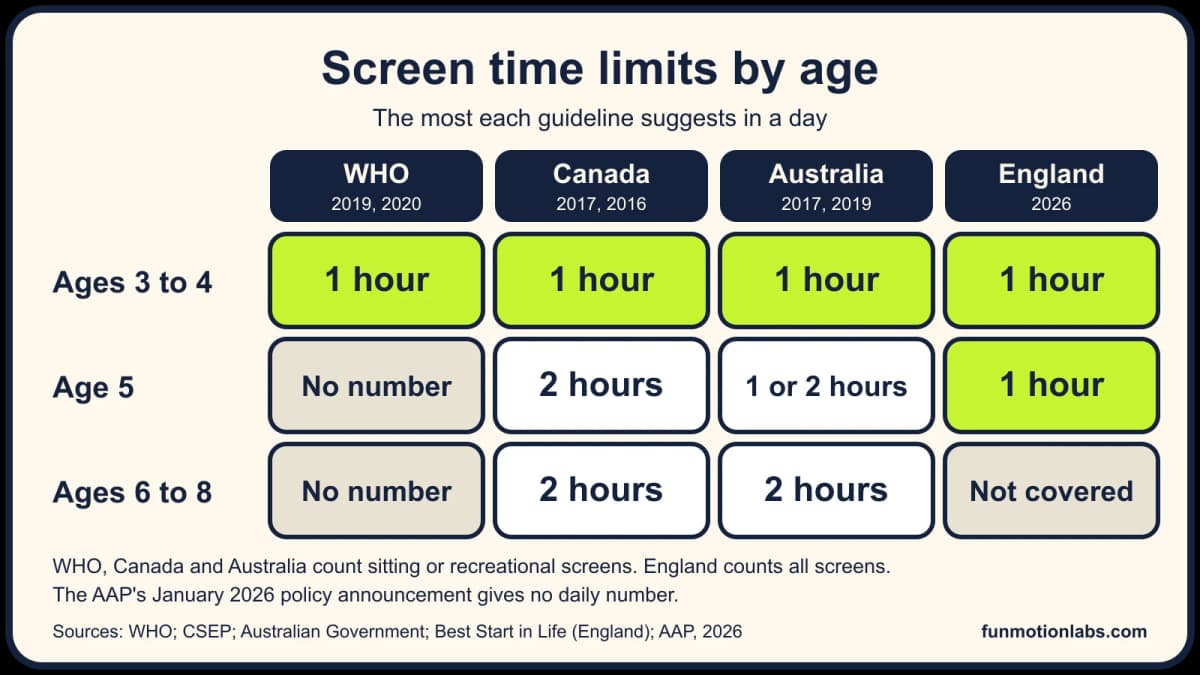
How much screen time should a 6-year-old have? Canada and Australia give the clearest number: no more than 2 hours a day of recreational screen time (Canada, ages 5 to 17). WHO's 2020 guidelines ask children aged 5 to 17 to limit recreational screen time but give no number.
Screen time for a 5-year-old is where the rules overlap. England's advice and Australia's early-years band still say about an hour, while Canada's school-age guideline says 2. If your child is 5, you could go with your country's guideline. Or start near an hour and see how it fits.
The numbers differ mostly because of age bands and wording. Preschool means 3 to 4 for WHO and Canada, 3 to 5 for Australia and 2 to 5 for England. There's a real limit in the research, too. Most studies behind these cutoffs are observational, so they can show that screen use and how children do go together, but not why. Each exact number is an expert panel's best judgement.
Be honest, is 2 hours of TV a day too much for a 4-year-old?
For a 4-year-old, 2 hours of TV a day is double the common 1-hour guideline, and it's also close to typical. Common Sense Media's 2025 census found US children aged 8 and under average about 2.5 hours of screen time a day. It climbs with age. Children aged 2 to 4 average about 2 hours (2:08), and children aged 5 to 8 about three and a half hours (3:28).
Canada looks similar. Its October 2026 early-years report card found that only 48% of under-5s meet the screen-time limit (ParticipACTION, via the University of Alberta). In the Common Sense census, about 1 in 5 US children aged 8 and under use a device to fall asleep most nights.
If your family is over, you're in the majority. That's a place to start from.
Does going over hurt? A 2019 Canadian study of 2,441 children linked more screen time at ages 2 and 3 with slightly lower development screening scores later. A 2020 review of 42 studies linked heavy screen use with weaker language skills. In the same review, watching together and choosing quality shows went with better language. The effects were small, and these are links. They can't tell us that screens caused the difference.
Is this really awful? Small swaps if you're over
Being over the guidelines is common, and the links researchers find are small. If you'd like to come down a little, one small swap is a gentle place to start.
Some days the screen is how dinner gets made. That's a real reason. If you want to try something, pick one.
- You could choose one screen-free spot, like dinner or the car. The AAP's 2026 announcement suggests media-free spaces like these, and England's advice suggests screen-free meals and bedrooms.
- Try a burst of movement before a show: 10 minutes of indoor energy-burning play, then the episode. There's more on how much activity kids need each day.
- Sit in on one show this week and chat about what happens.
- If evenings are bumpy, England's advice suggests no screens in the hour before bed. Our post on why kids get a burst of energy at night has more on evenings.
Cutting back without meltdowns gets a post of its own soon.
The show ends, and you glance at the clock again. This time you could try the AAP's crowding-out question instead: what did screens get in the way of today? Maybe nothing. Maybe the park waits until tomorrow.
This is general information, not medical advice. If you're worried about your child's development, sleep or behavior, talk to your pediatrician or family doctor. There's more on screens and play in our guide for parents, and you can see how we check our sources.
FAQ
What is a good limit for screen time for a 4-year-old?
About 1 hour a day is the most common screen time guideline for a 4-year-old. WHO (2019), Canada, Australia and England (2026) all suggest it. The AAP's January 2026 announcement gives no daily number, though one AAP parent page still suggests less than 1 to 2 hours. A single screen-free spot, like dinner, is one gentle place to start.
How many shows a day is OK for a 4-year-old?
No guideline counts shows. They count time. For ages 3 to 4, the common limit is about 1 hour a day, so the number of episodes depends on how long they are. England's 2026 advice also says "slow-paced, predictable content is better for young brains" than fast, social-media-style videos. Two slower 20-minute shows fit inside the hour.
Does the 1-hour limit include active or movement games?
It depends on the guideline. WHO's limit for ages 3 to 4 is for sedentary screen time, meaning time spent sitting. England's 2026 advice says screen time "of any kind" shouldn't replace sleep, physical activity or active play. There's more on how moving screens differ from sitting ones and in whether active video games count as exercise.
Sources
- World Health Organization (2019). To grow up healthy, children need to sit less and play more.
- Canadian Society for Exercise Physiology (2017 and 2016). 24-Hour Movement Guidelines for the Early Years and for Children and Youth. Dates: Canadian Institute of Child Health and Public Health Agency of Canada.
- Australian Government (2017 and 2019). 24-Hour Movement Guidelines for the Early Years and for Children and Young People.
- Best Start in Life, UK government, for England (published March 2026, updated June 2026). Screen time for under 5s. Expert report: Screen use by children aged under 5, GOV.UK.
- American Academy of Pediatrics, Center of Excellence on Social Media and Youth Mental Health (updated June 2026). Are there any risks associated for a 4-year-old with screen time with age-appropriate programming?
- American Academy of Pediatrics (2016). Media and Young Minds. Pediatrics.
- American Academy of Pediatrics (January 2026). American Academy of Pediatrics calls for creating a child-friendly digital world.
- HealthyChildren.org, American Academy of Pediatrics (updated 2024). Kids and screen time: 5 C's questions for toddlers and preschoolers.
- World Health Organization (2020). Guidelines on physical activity and sedentary behaviour for children and adolescents aged 5 to 17, International Journal of Behavioral Nutrition and Physical Activity.
- Common Sense Media (2025). The Common Sense Census: Media Use by Kids Zero to Eight.
- University of Alberta (October 2026). Canada's youngest generation off to healthy start, but screen time is a challenge (ParticipACTION Early Years Report Card).
- Madigan S and others (2019). Association between screen time and children's performance on a developmental screening test. JAMA Pediatrics.
- Madigan S and others (2020). Associations between screen use and child language skills: a systematic review and meta-analysis. JAMA Pediatrics.
Card: Fun Motion Labs. Cover photo by Mizuno K on Pexels.
We cite health bodies for health facts and never claim our games change your health. Our editorial policy