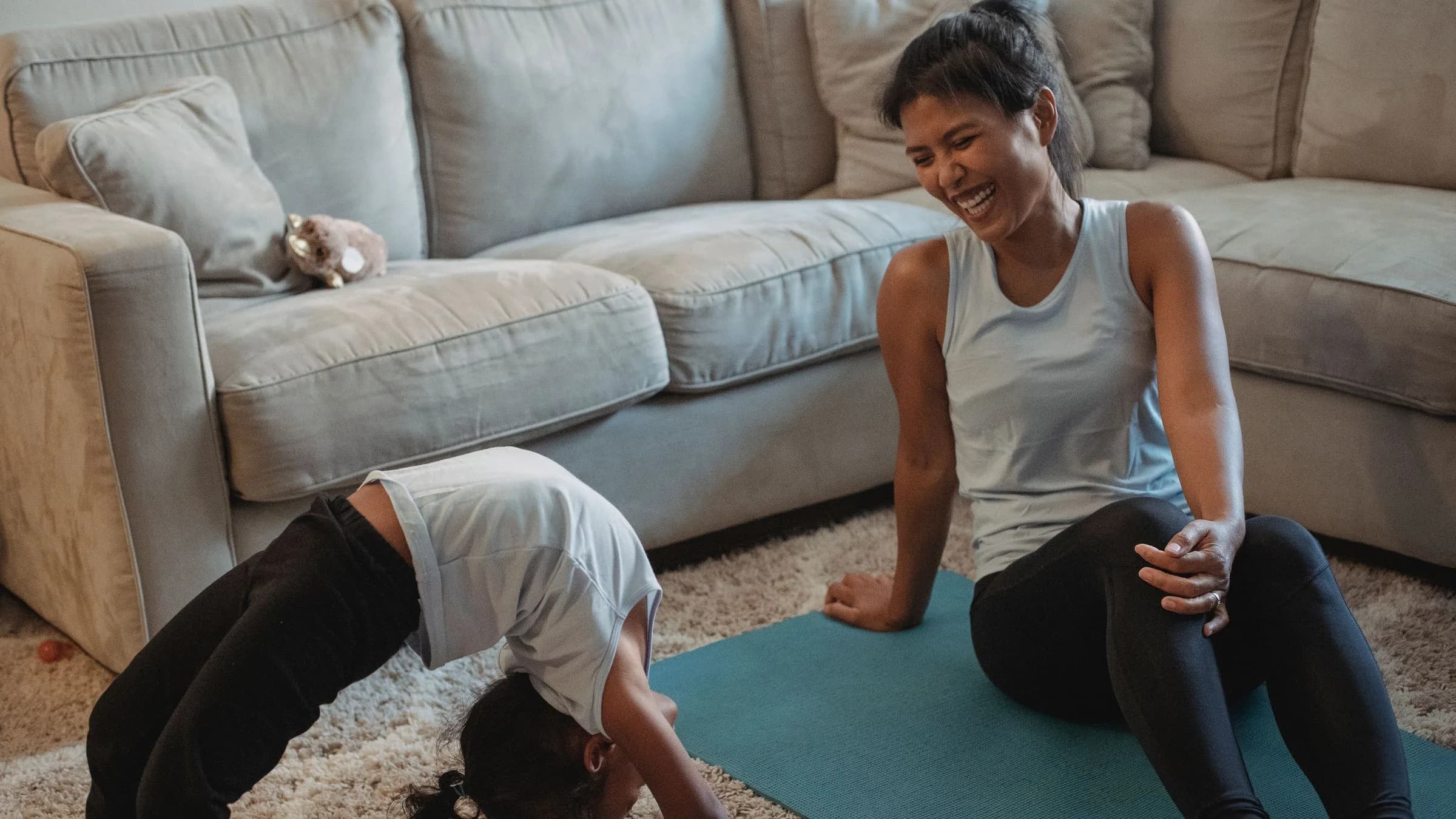
Every time your 4-year-old leaps off the sofa, you hear it twice. Once in your living room, and once as a broom handle knocking on the ceiling below. You've said "walking feet" all afternoon. And you still think a small child needs to move.
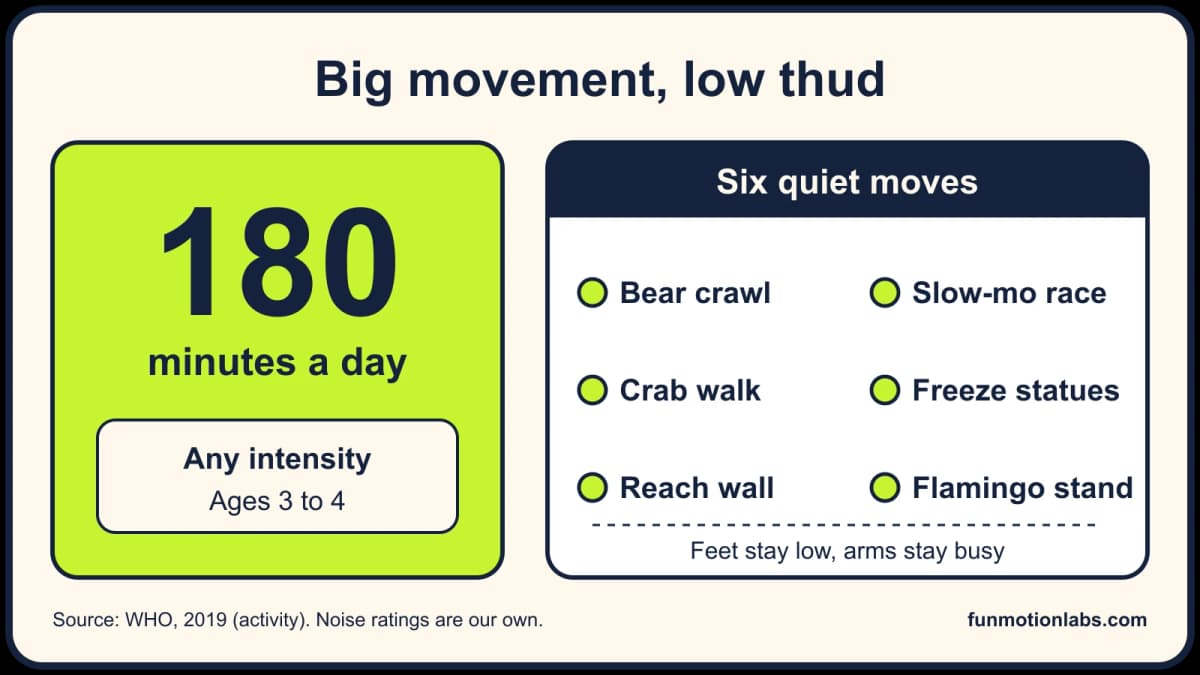
The short answer: Children aged 3 to 4 need at least 180 minutes of activity a day, and any intensity counts, says the World Health Organization (2019). In a flat, most of that can be "low thud, high movement" play, like reaching, crawling, balancing and slow-motion games. Jumping can stay, on a soft mat at a time your neighbors are fine with.
What are good apartment activities for toddlers?
Good apartment activities for toddlers and young kids use big movements that stay low to the floor or reach up into the air. Crawling, stretching, balancing, squatting and arm-heavy games make good indoor games for small spaces, because they need little floor and land softly.
Most of the thump downstairs comes from landings and running heels. Crawling and swinging arms make much less of it. That's our own view, and it's what parents in apartment threads describe. We couldn't find research that measures which kids' games sound loudest in the flat below, so the noise ratings in this post are our judgement.
The amount of movement still matters. The World Health Organization (2019) says children aged 3 to 4 need at least 180 minutes of activity a day. It can be "at any intensity," spread through the day. The US Physical Activity Guidelines (2018) add that young children are "naturally active in an intermittent way." So a dozen 5-minute bursts in a one-bedroom apartment is a real plan. There's more on how much activity kids need at each age.
What games can kids play in the living room without the thumping?
In a flat with neighbors below, a 4-year-old can still get the energy out. Most loud games have a quieter cousin that uses the same kind of movement. These swaps keep your child moving and take out most of the landing, and nearly all of them are indoor games with no equipment.
| Instead of | Try this quieter swap | Noise (our rating) | Space |
|---|---|---|---|
| Jumping off the sofa | "Popcorn": squat low, rise slowly, then pop up with the arms while feet stay down | Low | A mat |
| Running laps | Bear-crawl down the hallway, crab-walk back | Low | Hallway |
| Chase | Slow-motion race, where everyone keeps moving and the last one over the line wins | Very low | Small |
| Stomping dance party | Freeze statues on the rug, in socks | Low | Small |
| Kicking a ball | Balloon volleyball on your knees, over a scarf "net" | Low | Medium |
| Climbing furniture | Sticky-note reach wall: stretch high and squat low to grab the notes | Very low | Wall + 1 m (3 ft) |
| Hopping around | Flamingo stand: one leg, arms out, count to ten, swap legs | Very low | Mat-size |
All of these suit ages 3 to 8, and the extras are a balloon, a scarf and some sticky notes. Slow-motion races are also the rare game you can referee from the sofa. For a bigger list sorted by room size and minutes, see our indoor ideas by space and time.
If your child seems to need more than gentle stuff, the leg moves are the ones to lean on. A lab study of movement games tested 8 to 12 year olds (2019). Games that used the legs and whole body got them working harder than a game played mostly with the arms. That's an older group, but squats, bear crawls and slow lunges are quiet ways to use the legs at any age.
What quiet indoor activities for kids work while the baby is sleeping?
Quiet indoor activities for kids keep feet planted and arms busy. They fit best while a baby naps in the next room, early in the morning, late in the evening or while someone below is resting.
- Scarf dancing: big loops, circles and figure eights with a scarf, feet still, to one song.
- Air drawing: a rainbow, a giant house or the letters of their name, drawn in the air with the whole arm.
- Mirror me: you move your arms slowly and your child copies, then you swap leaders.
- Towel tug-of-war, both sitting on the floor with feet braced.
- A webcam game on a laptop is another option. In Magic Easel (ages 3+), children paint, fill and trace pictures in the air with their hands. It needs about 1.2 to 1.8 m (4 to 6 ft) of clear space. We make Fun Motion Labs, so weigh our pick with that in mind. Tracking and voice commands run on your computer. Your webcam video is never saved or uploaded.
Is jumping good for toddlers?
Yes. Jumping is a normal part of young children's play. WHO (2019) says at least 60 of the 180 daily minutes for ages 3 to 4 should be moderate to vigorous. Jumping is one easy way kids get there.
For ages 5 and up, the WHO's 2020 guidelines add vigorous play and moves "that strengthen muscle and bone" on at least 3 days a week. Jumping and climbing are the obvious examples, though that's our reading and not WHO's list.
So why does your toddler keep jumping? Mostly because it's new and it feels great. Young children are still learning to take off and land. The CDC lists hopping on one foot as something most children can do by age 5.
That means jumping can stay. It can just move. A thick mat, a folded duvet or a couch cushion on the floor softens the landing. Some families pick a "jump time" in the middle of the day, and others save the big jumps for the playground. Both are fair answers.
How do I keep my toddler quiet in an apartment?
You probably can't keep a toddler quiet in an apartment all day, and you don't have to. Aiming for quieter works better. Changing the surface, the timing and the kind of movement lets your child keep moving most of the day.
Plenty of parents in small homes ask some version of "can I let my kid be a kid?" Yes. These three changes make that easier on everyone.
The surface. A thick rug or foam play mats where most of the play happens soften every landing. Bare feet or socks with grips are quieter than shoes.
The timing. Many families keep the bounciest play for mid-morning or late afternoon. Early mornings, late evenings and a neighbor's nap time get the low-thud games. A herd of thundering hooves at 3 pm is a different thing from the same herd at 6:30 am. If late afternoon is already wild at your place, our post on the 4 to 6 pm witching hour covers that stretch.
The kind of movement. Running needs somewhere to go. A hallway bear-crawl race or a 10-step tiptoe "spy mission" gives the urge a job.
Kids aren't built to tiptoe all day. You're not a bad neighbor for having a child, and your neighbor isn't a bad person for wanting some quiet.
What can I say to downstairs neighbors about kids' noise?
A short, friendly chat before there's a problem tends to go better than a note after one. You could:
- say hello and introduce your child by name
- mention what you're already doing, like the rug and quiet mornings
- ask about their hard times, such as night shifts, a new baby or early alarms
- leave a phone number, so they can text you instead of knocking
What safety checks matter in a small space?
Small rooms put TVs and furniture closer to the action, so a two-minute check before active play is worth it. The US Consumer Product Safety Commission estimates about 17,800 emergency room visits a year after TV or furniture tip-overs (2023 report). Children under 18 make up 44% of those injuries.
- Anchor TVs, bookcases and dressers to the wall, as the CPSC advises (2024). Otherwise, a sturdy, low base with the TV pushed back and cords out of reach is the next best thing.
- Give arm games room to swing. Doctors have reported injuries when players hit furniture or walls during motion games, most often cuts to the hand.
- Push the coffee table aside and look for sharp corners at your child's head height.
Try this today
Pick one or two. Any of them counts.
- Put a rug, mat or folded duvet where the jumping happens.
- Stick 10 notes up and down a wall for a reach race.
- Ask your child to cross the hallway three ways: bear, crab, tiptoe.
- Choose one "loud hour" and one "quiet hour", and tell your neighbor.
- Anchor the TV or bookcase nearest the play space.
Your 4-year-old can still launch. Tomorrow it might be onto a duvet at 4 pm, with a wall of sticky notes waiting for 7 am.
There's more on play and screens in our guide for parents, and you can see how we check our sources.
FAQ
What if the neighbors complain about kids running?
If downstairs neighbors complain about kids running, a calm chat is a good first step. In most places, daytime play, footsteps and the odd thud are part of living near a family. If complaints keep coming, check your lease or building rules on quiet hours. You could also ask the building manager to sit down with you both. Rules differ between countries and buildings, so we can't say what counts as too loud where you live.
Is it OK to let a toddler run in an apartment?
That's your call, and families land in different places. Some keep a no-running rule indoors. Others hear "do you let your kids run in the house?" and say yes, in short bursts on a rug at sensible hours. If you allow it, a set route and a set time help your child and the people below. On hard floors, socks with grips are safer than plain socks.
Are mini-trampolines safe for toddlers indoors?
In a 2012 policy statement, the American Academy of Pediatrics said "the home use of trampolines is strongly discouraged." It noted that most trampoline injuries happen when several children are on the mat at once. The statement covers trampolines in general and doesn't single out small indoor ones. If you have one, the AAP's advice is one jumper at a time, no flips and an adult actively watching.
Sources
- World Health Organization (2019). To grow up healthy, children need to sit less and play more.
- US Department of Health and Human Services (2018). Physical Activity Guidelines for Americans, 2nd edition.
- Hwang J and others (2019). Exploring energy expenditure and body movement of exergaming in children of different weight status. Pediatric Exercise Science.
- World Health Organization (2020). Guidelines on physical activity and sedentary behaviour for children and adolescents aged 5 to 17, International Journal of Behavioral Nutrition and Physical Activity.
- US Centers for Disease Control and Prevention. Milestones by 5 years. Learn the Signs. Act Early.
- US Consumer Product Safety Commission (February 2024). Product Instability or Tip-Over Injuries and Fatalities Associated with Televisions, Furniture, and Appliances: 2023 Report.
- US Consumer Product Safety Commission (8 February 2024). Ahead of Sunday's game, CPSC reminds families to tackle the deadly hazard of TV and furniture tip-overs.
- Sparks D and others (2009). Wii have a problem: a review of self-reported Wii related injuries. Informatics in Primary Care.
- Briskin S, LaBotz M and the AAP Council on Sports Medicine and Fitness (2012). Trampoline safety in childhood and adolescence. Pediatrics.
Card: Fun Motion Labs. Cover photo by Kamaji Ogino on Pexels.
We cite health bodies for health facts and never claim our games change your health. Our editorial policy