
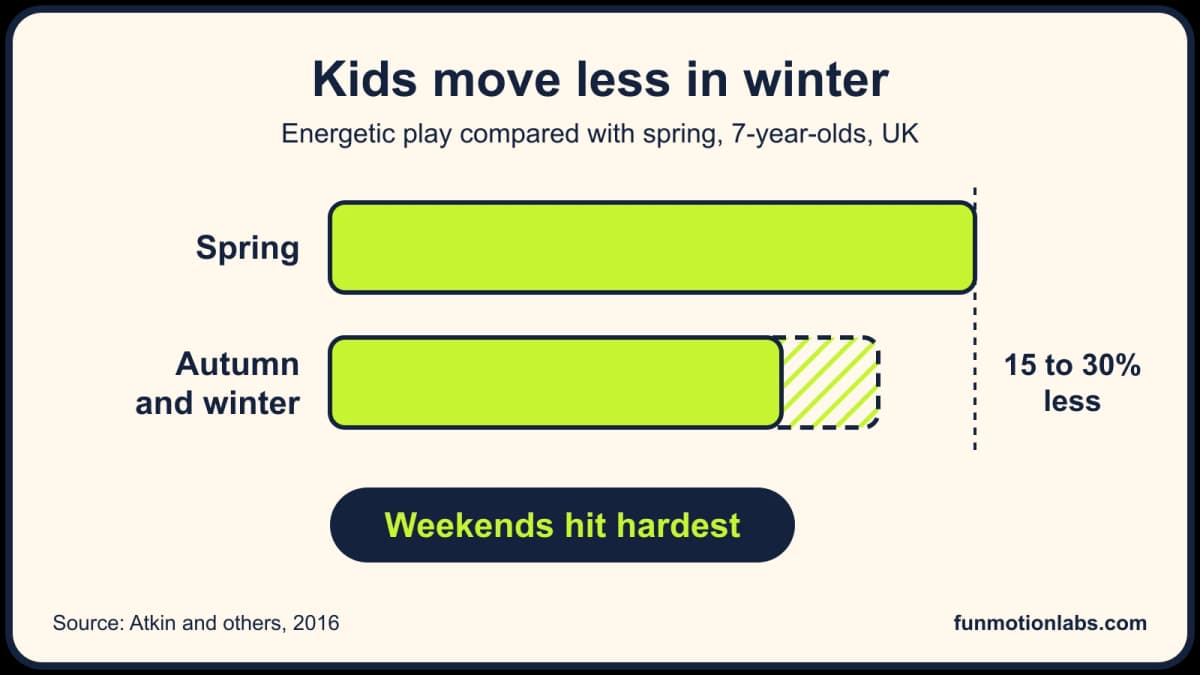
It's dark by 4, the park is a swamp and the afternoons feel so long. In one UK study, 704 seven-year-olds wore activity monitors at different times of year. Their energetic play sank in autumn and winter, and it sank furthest at weekends. Weekends are meant to be the free days. So why there, and how do you keep kids active in winter anyway?
The short answer: Most children move less in winter. In a UK study of 7-year-olds wearing activity monitors (2016), energetic play in autumn and winter ran 15 to 30% below spring levels. Weekends were hit hardest. A simple answer to how to keep kids active in winter is a short trip outside most days, an indoor game after school and a bigger weekend outing.
Do kids move less in winter?
Yes. Most studies that follow children through the year find they move less in winter, and for school-age kids the drop can be big.
The UK study from the top of this post tracked 704 children aged 7 (Medicine and Science in Sports and Exercise, 2016). Its 15 to 30% drop is in energetic play, which researchers call moderate-to-vigorous activity. The World Health Organization (2019) describes it as active play that leaves children out of breath and feeling warm. Think running, dancing or a ball game, more than a stroll.
That study isn't alone. A 2012 review found that in every UK study it looked at, children were most active in summer and least active in winter. Looking wider, a 2010 review of 35 studies from several countries found seasonal swings in 29 of them (83%).
The picture is fuzzier for preschoolers. That 2010 review found the pattern less consistent in young children, and the studies we found on 3 to 5 year olds are small. So the winter dip is clearest in kids of about 7. In younger ones it probably happens too, but it's less well measured.
Why is winter hardest at weekends and at home?
The winter dip lands hardest at weekends and at home, where children lose the outdoor time and the timetable that school or preschool gives them.
In the UK study, the winter drop was especially large at weekends. A small US study of 46 preschoolers (2013) points the same way. The slump was much smaller while children were at preschool. It showed up mostly at home, after preschool and on weekends.
Weather adds to it. A 2017 analysis pooled activity data on more than 23,000 children. It linked wet, windy and darker days with less movement, more so in younger children. One detail stood out. Children in northern Europe and in Melbourne, Australia, kept moving better in bad weather than children elsewhere. The study can't tell us why. Our guess is habit and kit, in the spirit of the old line "no bad weather, only bad clothes."
At school, play is on the timetable. On a wet Saturday at home, nobody rings a bell for break, and it's easy to stay stuck inside until dark.
Is it worth going out when it's cold and dark?
Yes. For children aged 3 to 8, a short trip outside in winter still counts. Even a 15-minute walk round the block with a flashlight (a torch, in the UK) is real activity.
Physical activity for kids in winter has the same targets as the rest of the year, because the guidelines don't change with the seasons. The World Health Organization (2019) recommends at least 180 minutes of activity a day for 3 to 4 year olds. From age 5, WHO's 2020 guidelines recommend an average of 60 energetic minutes a day. There's more on how much activity kids need by age in our full guide.
Small amounts are worth having. When the UK's chief medical officers refreshed their guidance in July 2026, the headline was that every movement counts. A 2015 Canadian expert statement went further on outdoor play. It called active play outside, risks included, essential for children to grow up healthy.
Ten minutes in the drizzle doesn't look like much from the window. From the sidewalk, with a puddle to aim at, it feels different.
If you're unsure about the temperature or the layers, our guide to how cold is too cold to play outside has the cut-offs.
How to keep kids active in winter: a simple week plan
A winter week plan for kids aged 3 to 8 can give each weekday one short outdoor burst and one indoor burst. The weekend gets a bigger outing, since that's where the research finds the biggest dip.
Planning ahead has some backing. A 2007 review of 37 studies on season, weather and activity suggested offering indoor options through the cold, wet months. This plan is ours, built around the gaps in the research. Screenshot it for the fridge.
| Day | Outdoor burst (10 to 20 min) | Indoor burst (10 to 15 min) |
|---|---|---|
| Monday | Walk or scoot home the long way | Freeze dance, three songs |
| Tuesday | Frost or puddle hunt in the yard or street | Hallway bowling with plastic bottles |
| Wednesday | Flashlight walk round the block after dark | Bear crawls and crab walks down the hall |
| Thursday | Playground stop on the way home | Sock snowball fight |
| Friday | "Race you to the lamppost" | Kitchen disco while dinner cooks |
| Saturday | Morning outing before screens go on, to a park or the woods | Cushion obstacle course after lunch; if it pours, a dance video or a motion game |
| Sunday | Family walk with a "find 5 things" list | Balloon volleyball, or a swim if you can |
The outdoor burst goes first on most days, while there's still some light. The indoor one fills the stretch between school pickup and dinner, which many families find the longest part of a winter day. At weekends, a morning outing gives the day a shape before anyone settles on the sofa.
The same plan covers winter break activities for kids at home, with the weekend rows used on weekdays as well. And if you're trying to survive winter with a toddler, the bursts can shrink to 5 minutes and come round more often.
The motion game link goes to ours. We make Fun Motion Labs, launching November 2026. We'd count a game as one extra way to move on a wet day, never a swap for the morning outing.
Some weeks the plan is one flashlight walk and a lot of cartoons. That's still a week with movement in it.
Stuck inside and stir crazy? Winter activities for kids indoors
On days too wet or too cold to go out, a few living-room games get children aged 3 to 8 moving with little space or kit. If the plan's games wear thin by February, these make good swaps:
- Tape-line long jump, where they try to beat their last mark
- A circuit of 10 jumping jacks (star jumps), 5 frog jumps and a crawl under the table
- Follow the leader around the house, with a new leader at every door
- Mirror me, where you do a slow move, they copy, then you swap
If cabin fever sets in by Wednesday, one option is to let your child make up the rules for the next game. For more, we sorted indoor games by space and time, and if there are neighbors below you, try these quiet games for apartments.
Before any big indoor game, the US Consumer Product Safety Commission (2024) advises anchoring TVs and heavy furniture to the wall.
Try this today
Pick one for tomorrow. The rest can wait.
- Get coats on and go out for 10 minutes before dark, even just round the block.
- Choose tomorrow's after-school indoor game now.
- If it fits your weekend, plan Saturday morning outside before screens go on.
- Put the week plan on the fridge and let your child pick one game a day.
- Keep a winter bag by the door with hats, gloves, a flashlight and spare socks.
Next Saturday at 9:30, the boots go on before the rain does. One loop of the park, home for lunch, and after lunch a 15-minute circuit round the living-room cushions.
You'll find more on play and screens in our guide for parents, and you can see how we check our sources.
FAQ
How do I keep my toddler active in winter?
For a 3-year-old, short bursts of play spread through the day all add up, and they don't all need to be energetic. The US Physical Activity Guidelines (2018) say that for preschoolers, activity of any intensity counts, light play included. One outing a day plus a few short indoor games is a rhythm that's easy to keep up in winter. Walking to the shops counts too.
How many hours a day should kids play outside in winter?
None of the guidelines we use set a number of hours outdoors, in winter or any other season. WHO, the US and the UK count total activity, indoors or out. The UK guidelines (updated 2026) name outdoor play for 3 to 4 year olds but give it no separate number. In winter, a few short trips outside add up. On bitter days, check the temperature cut-offs first.
What are good winter break activities for kids at home?
Over winter break (the Christmas holidays, in the UK), the weekend rows of the week plan work on weekdays too. A morning outing, then two short indoor bursts in the afternoon, is an easy pattern to repeat for a couple of weeks. Swap in a new indoor game every few days so it stays fresh, and keep one quiet afternoon slot for films and naps.
Sources
- Atkin AJ and others (2016). Seasonal variation in children's physical activity and sedentary time. Medicine and Science in Sports and Exercise.
- World Health Organization (2019). Guidelines on physical activity, sedentary behaviour and sleep for children under 5: glossary.
- Rich C and others (2012). Seasonal variation in accelerometer-determined sedentary behaviour and physical activity in children: a review. International Journal of Behavioral Nutrition and Physical Activity.
- Carson V and Spence JC (2010). Seasonal variation in physical activity among children and adolescents: a review. Pediatric Exercise Science.
- Shen B and others (2013). An exploratory study of seasonality and preschoolers' physical activity engagement. Journal of Physical Activity and Health.
- Harrison F and others (2017). Weather and children's physical activity; how and why do relationships vary between countries? International Journal of Behavioral Nutrition and Physical Activity.
- World Health Organization (2019). To grow up healthy, children need to sit less and play more.
- Chaput J-P and others (2020). 2020 WHO guidelines on physical activity and sedentary behaviour for children and adolescents aged 5 to 17 years. International Journal of Behavioral Nutrition and Physical Activity.
- UK Government (10 July 2026). New UK CMO activity guidelines show every movement counts.
- Tremblay MS and others (2015). Position statement on active outdoor play. International Journal of Environmental Research and Public Health.
- Tucker P and Gilliland J (2007). The effect of season and weather on physical activity: a systematic review. Public Health.
- US Consumer Product Safety Commission (8 February 2024). Ahead of Sunday's game, CPSC reminds families to tackle the deadly hazard of TV and furniture tip-overs.
- US Department of Health and Human Services (2018). Physical Activity Guidelines for Americans, 2nd edition.
- UK Chief Medical Officers (updated July 2026). Physical activity guidelines.
Chart: Fun Motion Labs. Cover photo by Vika Glitter on Pexels.
We cite health bodies for health facts and never claim our games change your health. Our editorial policy