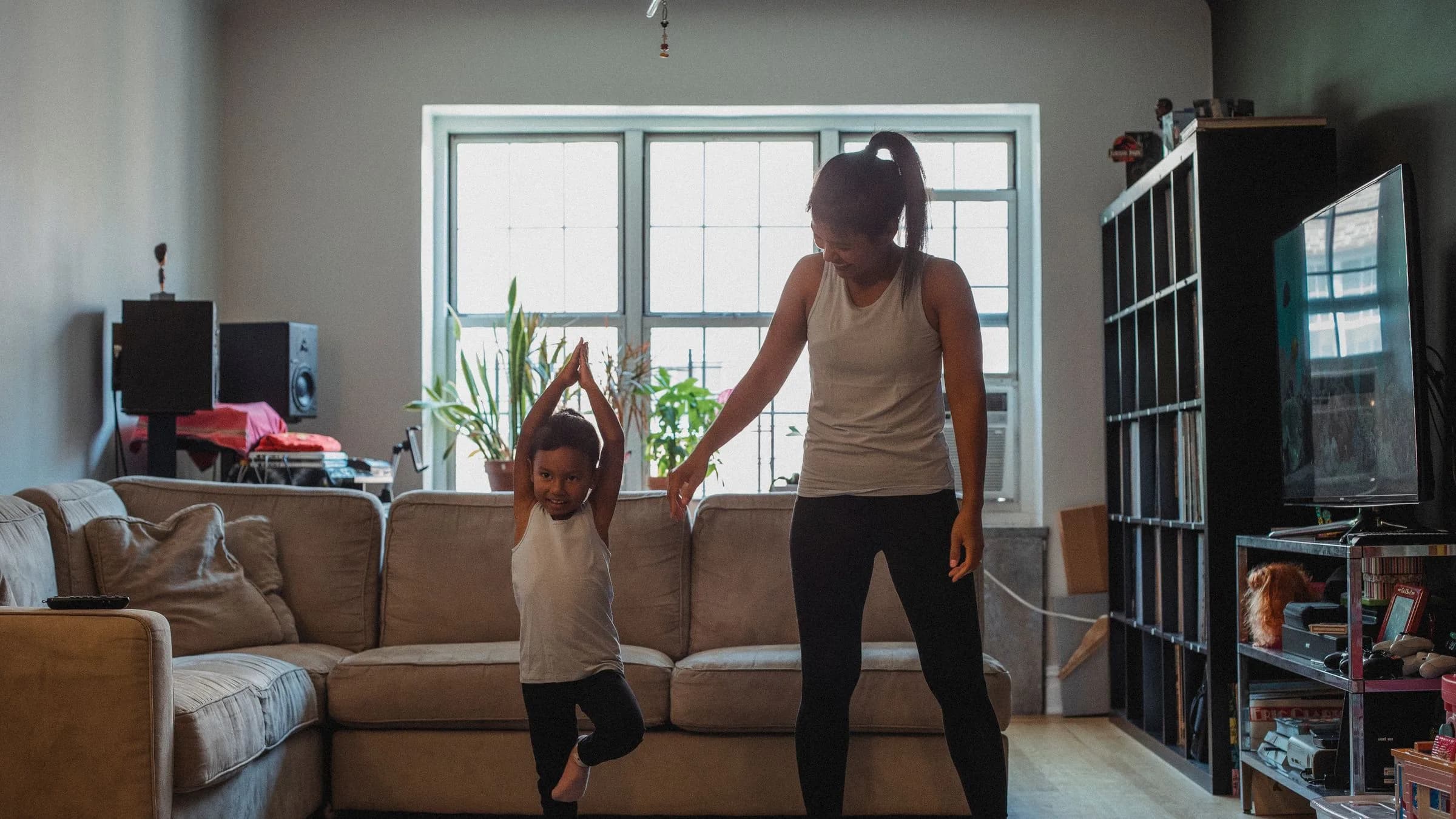
The teacher said he "never stops moving." You smiled, nodded, and then turned it over in your head all the way home. So how long can a 4-year-old sit still, really? Less time than most of us expect.
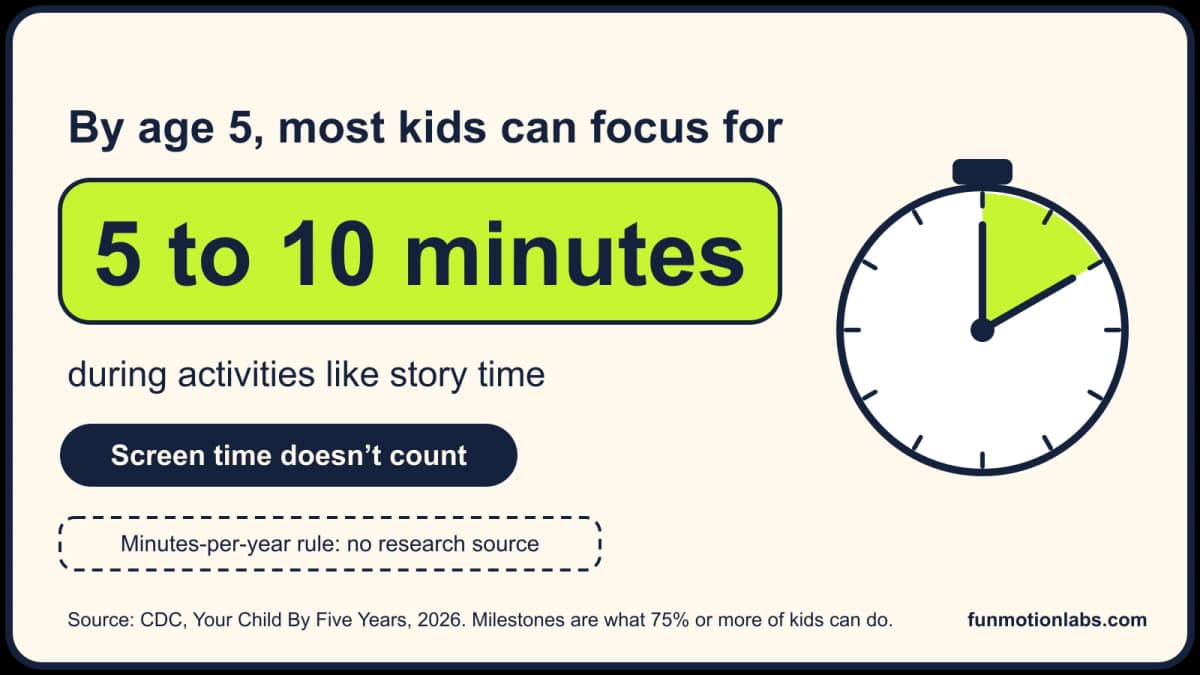
The short answer: Most 4-year-olds can sit and focus on one activity for only a few minutes at a time. The CDC (2026) lists paying attention for 5 to 10 minutes during activities like story time as a milestone most children reach by age 5. Screen time doesn't count. Short movement breaks between quiet tasks are normal.
How long can a 4-year-old sit still and pay attention?
A 4-year-old can usually sit and focus for a few minutes at a time. Most children reach about 5 to 10 minutes of attention during activities by age 5, according to the CDC (2026).
The CDC's milestone for age 5 reads "Pays attention for 5 to 10 minutes during activities," with story time or arts and crafts as examples. Screen time doesn't count. Milestones are things most children (75% or more) can do by that age, so plenty of children get there a little later. The CDC's list for age 4 has no attention milestone at all.
You'll often see "2 to 3 minutes per year of age" online. It's a rule of thumb, and we couldn't trace it to any research. Treat it as a rough guess rather than a target.
So how long should a 5-year-old be able to sit still? By the CDC's milestone, most 5-year-olds can pay attention for about 5 to 10 minutes during an activity like story time. If you're looking for attention span by age, that's the clearest sourced number we found.
Should a 4-year-old be able to sit still? Is it normal that mine can't?
Most 4-year-olds can't sit still for long, and that's normal. The NHS (2025) says children under 5 shouldn't be inactive for long periods, except when they're asleep. The US activity guidelines (2018) say children are "naturally active in an intermittent way," which means they move in short bursts.
Sitting nicely is a skill. It grows slowly with age and practice, and it bends a lot with interest. A child who wriggles through a worksheet may sit through a whole book about diggers. Being tired or hungry makes it harder too, as anyone who has tried a long dinner at 5 pm knows.
If your toddler won't sit still, or your preschooler struggles to sit still at carpet time, you have lots of company. Parents have plenty of names for it, from ants in his pants to a wiggle bum to a forever fidgeting 5-year-old.
For how much moving young children need each day, there's more on how much physical activity kids need at each age.
Do movement breaks help kids focus? What the studies found
Classroom studies have found that short movement breaks help children stay on task afterward. Evidence that they raise grades is weak.
| Study | Who | What they found | How strong |
|---|---|---|---|
| Classroom activity breaks, 2006 | 62 US children, about 8 to 10 | On-task behavior up 8%, and up 20% for the least on-task kids | One school, small |
| Classroom movement, 2017 | Primary-school children | Helped kids stay on task; effect on thinking skills unclear | Meta-analysis |
| Activity programs, 2017 | Ages 4 to 13 | Small boosts to math and reading; a bigger boost to time on task | Meta-analysis, small effects |
| Movement-break programs, 2018 | School-age children | 9 of 11 programs improved classroom behavior; evidence for better grades lacking | Review of low-to-medium quality studies |
| Activity programs for preschoolers, 2026 | 31 trials, ages 2 to 6 | Small-to-moderate gains in self-control, memory and flexible thinking | Meta-analysis; bigger effects against passive control groups |
Almost all of this research happened in school classrooms, with children older than 4. The 2026 analysis comes closest to preschoolers, but it looked at planned activity programs rather than quick breaks. We couldn't find a study of short movement breaks at a kitchen table with 4-year-olds. That makes breaks a reasonable thing to try at home, with no guarantees.
The American Academy of Pediatrics (2018) makes a broader point about play. It calls play "not frivolous" and says it helps build skills like self-control, though much of the brain research behind that was done in animals.
Movement breaks for kids at home: a 3-minute menu
At home, a movement break can be as short as 1 to 3 minutes between quiet tasks, like before homework, before a meal or halfway through a story. Some teachers call these brain breaks, which just means a short burst of moving between sitting jobs. The times here are our suggestion and don't come from a study.
Pick whichever fits the moment.
- Before a meal, walk to the table like a bear, a crab or a frog.
- Before homework or drawing, do 10 wall push-ups, then 10 big reaches for the ceiling.
- Halfway through a story, act out the page. Be the bear, stomp softly, then freeze.
- After a long car ride, shake it out with 10 shakes for each arm and each leg.
- When it's time to wind down, try slow animal yoga, like a tree, a cat or a frog.
A timer your child can see makes the end of a break clear. So does finishing with one big freeze. Some kids like inventing the next move themselves, which can make the whole thing feel like their idea.
If you live above or beside neighbors, there are quieter ideas for small apartments. For days that need more than 3 minutes, try these indoor ways to burn off energy.
Games that mix moving and learning
You can tuck letters and numbers into a break. Tape a few letters on the floor and call one out to hop to, jump to the number on a card, or play "reach for something red." We make Fun Motion Labs, and our Learn & Leap game (ages 3 to 7) is a webcam version where kids reach for the right number, letter or color. Tracking and voice commands run on your computer. Your webcam video is never saved or uploaded.
The teacher says my child struggles at carpet time. Should I worry?
Your child may struggle to sit still at carpet time in reception, kindergarten or prep. On its own, that fits the normal range for 4 and 5-year-olds described above. A good first step is to ask the teacher when it happens and what already works in class. Teachers see your child in a group every day, so they're good partners for this.
A few questions you could bring:
- Is it harder at certain times, like after lunch or during worksheets?
- Is it getting in the way of learning or friendships?
- Do you use movement breaks or fidget tools in class?
- Is there something we could copy at home?
It's worth talking to your pediatrician or family doctor if the restlessness is there all the time, in every setting. The same goes if it's getting in the way of friendships, safety or learning. You don't need a big reason to ask. A question at a regular check-up is fine.
Try this today
No need to do all five. One is plenty for tonight.
- Time one story tonight and notice when the wiggles start. That gives you a picture of your child's normal right now.
- Add a 1-minute break halfway through.
- Do a bear walk to the dinner table.
- Tape five letters on the floor for a hop game.
- Ask the teacher one question: "When is it hardest for them?"
Next time the teacher mentions he never stops moving, you'll know that a few minutes of story time is a normal stretch at 4. And tonight, there's a bear walking to dinner.
This is general information, not medical advice. If you're worried about your child's development, sleep or behavior, talk to your pediatrician or family doctor. There's more on play and screens in our guide for parents, and you can see how we check our sources.
FAQ
How long should a 3-year-old sit still?
For most activities, only a few minutes. The CDC's 5 to 10 minute attention milestone is for age 5, so a 3-year-old has a couple of years to grow toward it. A 3-year-old who listens to a short story and then needs to get up is well within the usual range.
Why can't my child sit still while eating?
Meals can feel long to small children, and sitting through one is a skill that comes with time. A short movement break before the meal, a shorter sit with a clear end, and a step under their feet may all help. If dinner lands in the 4 to 6 pm witching hour, tiredness may be part of it. If eating itself is a struggle, your doctor is a good person to ask.
My child can watch TV for an hour but can't sit for a story. Why?
Lots of children do this. The CDC's 5 to 10 minute attention milestone is about activities like story time or crafts. The CDC says screen time does not count toward it. So an hour of TV doesn't tell you much about attention. A wiggly story time isn't a sign that something is wrong, either.
What are brain breaks for preschoolers, and do they work?
Brain breaks are short bursts of movement between quiet tasks. Classroom studies, mostly with school-age children, found that short movement breaks help kids stay on task afterward. Closer to this age, a 2026 analysis of 31 trials found activity programs gave preschoolers small-to-moderate gains in self-control, memory and flexible thinking. Those were planned programs run by researchers. A quick break at home is a gentler version of the same idea.
Sources
- Centers for Disease Control and Prevention (reviewed May 2026). Important milestones: your child by five years.
- NHS (reviewed 2025). Physical activity guidelines for children (under 5 years).
- US Department of Health and Human Services (2018). Physical Activity Guidelines for Americans, 2nd edition.
- Mahar MT and others (2006). Effects of a classroom-based program on physical activity and on-task behavior. Medicine and Science in Sports and Exercise.
- Watson A and others (2017). Effect of classroom-based physical activity interventions on academic and physical activity outcomes: a systematic review and meta-analysis. International Journal of Behavioral Nutrition and Physical Activity.
- Álvarez-Bueno C and others (2017). Academic achievement and physical activity: a meta-analysis. Pediatrics.
- Daly-Smith AJ and others (2018). Systematic review of acute physically active learning and classroom movement breaks on children's physical activity, cognition, academic performance and classroom behaviour. BMJ Open Sport and Exercise Medicine.
- Liu W and others (2026). The effects of physical activity on executive function in preschool children: a meta-analysis of randomized controlled trials. Frontiers in Psychology.
- Yogman M and others, American Academy of Pediatrics (2018). The power of play: a pediatric role in enhancing development in young children. Pediatrics.
Card: Fun Motion Labs. Cover photo by Kamaji Ogino on Pexels.
We cite health bodies for health facts and never claim our games change your health. Our editorial policy